Get Free Shipping on orders over $79
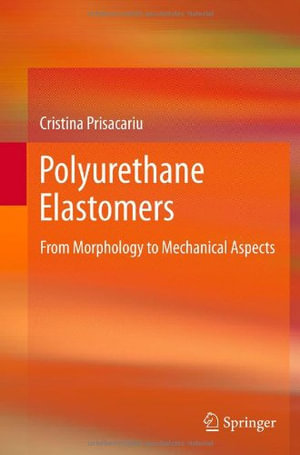
Polyurethane Elastomers : From Morphology to Mechanical Aspects - Cristina Prisacariu

Polyurethane Elastomers

From Morphology to Mechanical Aspects

By: Cristina Prisacariu

Hardcover | 3 July 2011

At a Glance

Hardcover


$259.01

or 4 interest-free payments of $64.75 with

 or 

Ships in 5 to 7 business days

Introduction.

The past and the present of polyurethanes (PUs).

Chapter 1

Chemistry of PUs

1.1.Macrodiols

1.2.Chain Extenders (diols and diamines)

1.3.Diisocyanates

1.3.1Conventional model rigid diisocyanates

1.3.1.1.Diisocyanates reactivity with alcohols

1.3.1..2.Diisocyanates reactivity with diols

1.3.1.3. Secondary reactions of diisocyanates group during polyurethane formation

1.3.1.4. Methods to investigate the mechanism of polymer crystallization

1.3.2. 4ovel flexible diisocyanates: their versatility to polyaddition processes

1.4. PUs preparation methods. The effect of reaction conditions on structure heterogeneity

Chapter 2

Hydrogen bonding in polyurethanes

2.1. Hydrogen bond influence on polyurethane formation

2.2. Effect of hydrogen bonding on phase separation

2.3. Effect of the hard segment nature (crystallizing or not) on hydrogen bonding

2.4. Effect of hydrogen bonding on mechanical properties

Chapter 3

PUs morphology and thermal behaviour. Crystallinity and phase segregation as revealed by:

3.1. Structural studies (WAXS, SAXS, SANS)

3.2. Thermal methods (DCS, DMA, TGA, thermal creep)

3.3. Morphology (IR dichroism; SEM)

3.4.IR spectroscopy

3.4. A comparison between conventional PUs based on rigid, hard segments (not crystallizing) and novel

PUs derived from the flexible DBDI giving hard segments of constitutional mobility (crystallizing or not).

Chapter 4

PUs Mechanical Properties

4.1.General considerations

4.1.1. Influence of Hydrogen bonding on the mechanical properties. (A comparison between PUs with

hydrogen bonding and analogous structures but achieved without hydrogen bonding)

4.1.1.1. Hydrogen substitution with Deuterium. Deuterated PUs.

4.1.1.1.1 Deuterated PUs achieved with deuterated chain extenders.

4.1.1.1.2.Deuterated PUs achieved with deuterated macrodiols.

4.1.1.2. Hydrogen substitution with inert (-CH3) groups

4.1.1.2.1. Partial Hydrogen substitution.

4.1.1.2.2. Total Hydrogen substitution

4.1.1.Influence of the type of soft segment macrodiol

4.1.2. Influence of hard segment nature (crystallizing or not)

4.1.3. Influence of the type chain extender.

4.1.4. Influence of the polyaddition procedure.

4.2. Elasticity and inelasticity. Inelasticity measures.

4.2.1 Tensile Modulus.

4.2.2 Hysteresis: work input and unrecovered strain.

4.2.3.Mullins effect

4.3. Creep and Stress Relaxation

Chapter 5.

Sensitivity of elasticity to PUs chemical and physical structure

5.1. Variation of cyclic tensile responses with PUs degree of crystallinity

5.2. Variation of cyclic tensile responses with PUs degree of phase separation.

Chapter 6.

PUs strain induced orientation and crystallization

6.1. Orientation of structure under tensile deformation as revealed by WAXS and SAXS

measurements

6.2. Orientation and crystallization of PU microstructure as revealed by dichroic measurements

Conclusions

Perspectives

Industry Reviews

Jiri G. Drobny, President
Drobny Polymer Associates
Merrimack, NH USA


The book is written by a true expert on the subject. It is not only a review of the state of the art but also a collection of new contributions in some specialized areas. The size of the publication is only 250 pages but it is amazing how much it covers: chemistry, structural studies, thermal behavior, mechanical aspects, morphology, new developments, and perspectives. The treatment of the subject is thorough and systematic, yet the text is clearly written and the style is readable. Given that, the book will be a very useful resource for a wide range of readers, from advanced students to university educators and scientists working in the field of polyurethane elastomers.

Other Editions and Formats

Paperback

Published: 12th October 2014

More in Plastics & Polymers Technology

Introduction to Polymers : 3rd edition, 2011 - Robert J. Young

RRP $131.00

$98.75

25%
OFF
Polymer Supported Organic Catalysts - Narendra Chauhan
Mechanics of Solid Polymers : Theory and Computational Modeling - Jorgen Bergstrom
Caring for Plastics in Collections - Mary Coughlin

RRP $117.75

$115.99

Aerospace Materials : Novel Technologies and Practical Applications - Kinga  Korniejenko