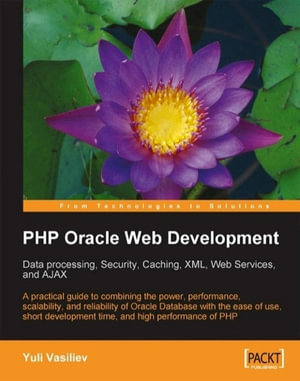
A practical guide to combining the power, performance, scalability, and reliability of the Oracle Database with the ease of use
Key Features
- Program your own PHP/Oracle application
- Move data processing inside the database
- Distribute data processing between the web/PHP and Oracle database servers
- Create reusable building blocks for PHP/Oracle solutions
- Use up-to-date technologies, such as Ajax and web services, in PHP Oracle development
Book Description
Oracle Database gets high marks for performance, reliability, and scalability. Building and deploying your PHP applications on Oracle Database enables you to combine the power and robustness of Oracle and the ease of use, short development time, and high performance of PHP. When used in a complementary way, PHP and Oracle allow you to build high-performance, scalable, and reliable data-driven Web applications with a minimum of effort.When building a PHP/Oracle application, you have two general options. The first is to use an Oracle database just to store data, performing all the operations on that data on the client side; the other is to use the database not only to store data, but also to process it, thus moving data processing to the data. While building the key business logic of a database-driven PHP application inside the database is always a good idea, you should bear in mind that not all of the databases available today allow you to do. The Oracle database, which offers record-breaking performance, scalability, and reliability, does. The partnership of Oracle and the open-source scripting language PHP is an excellent solution for building high-performance, scalable, and reliable data-driven web applications.This 100% practical book is crammed full of easy-to-follow examples. It provides all the tools a PHP/Oracle developer needs to take advantage of the winning combination. It addresses the needs of a wide spectrum of PHP/Oracle developers, placing the emphasis on the most up-to-date topics, such as new PHP and Oracle Database features, stored procedure programming, handling transactions, security, caching, web services, and Ajax.
What you will learn
- Install and configure PHP and Oracle software
- Connect PHP with Oracle
- Move key application business logic into the database
- Build transactional PHP/Oracle applications
- Use security features of PHP and Oracle
- Improve performance with caching
- Employ XML features of PHP and Oracle
- Implement SOAP Web services with PHP and Oracle
- Build Ajax-driven PHP/Oracle solutions
- Chapter 1 gives an overview of the PHP and Oracle technologies, explaining why you might want to use PHP in conjunction with Oracle.Chapter 2 covers the basics of using the PHP OCI8 extension to interact with an Oracle database from PHP. It also briefly discusses some popular alternatives to the OCI8 extension to connect to Oracle from within PHP.Chapter 3 discusses how you can move data processing performed by your PHP/Oracle application into the database by using sophisticated SQL queries, stored PL/SQL procedures, and database triggers.Chapter 4 discusses the various mechanisms that can be used to perform transactions with PHP and Oracle.Chapter 5 examines the object-oriented approach to developing PHP/Oracle applications, as an efficient means to reduce the development time and complexity, and increase the maintainability and flexibility of your applications.Chapter 6 discusses how to effectively use the security features of both PHP and Oracle together, examining the fundamental aspects of building a secure PHP/Oracle application.Chapter 7 discusses how to effectively use caching mechanisms available in PHP and Oracle and provides several examples of caching in action.Chapter 8 explains how to effectively use XML techniques and technologies available in PHP and Oracle when building XML-enabled PHP/Oracle applications.In Chapter 9 you learn how to build a SOAP Web service exposing the functionality of a PHP/Oracle application, using the PHP SOAP extension and Oracle XML technologies.Chapter 10 explains how Ajax and some other client-side (browser-side) JavaScript technologies can be used along with Oracle Database technologies as well as PHP features to improve the responsiveness of PHP/Oracle applications.An Appendix covers installation of PHP and Oracle software.
Who this book is for
Although this book covers only the most popular and up-to-date topic areas on the use of PHP in conjunction with Oracle, the author does not make any assumption about the skill level of the reader. Packed with information in an easy-to-read format, the book is ideal for any PHP developer who deals with Oracle.alt="Buy PHP Oracle Web Development: Data processing, Security, Caching, XML, Web Services, and Ajax" title="Buy PHP Oracle Web Development: Data processing, Security, Caching, XML, Web Services, and Ajax