

At a Glance
Paperback
128 Pages
128 Pages
Dimensions(cm)
15.9 x 23.5 x 0.9
15.9 x 23.5 x 0.9
Paperback
$40.00
or 4 interest-free payments of $10.00 with
orShips in 5 to 7 business days
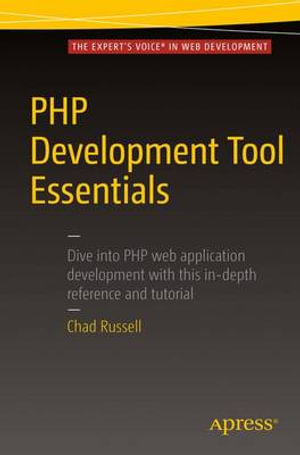
Pro PHP and MySQL aims to pick up where Jason Gilmore's best-selling Beginning PHP and MySQL leaves off. Although there are some similar topics touched on with each book, this in-depth "dive-in"-like book aims to further expose the reader into the many different methodologies, tools, and concepts that professional web developers are using more and more each day. In this book, author Chad Russell teaches you PHP development best practices, such as version control, development environment virtualization, and coding standards. You'll also learn how to employ PHP design patterns to your web application development techniques and applications, giving you all the skills you need to write high-performing, elegant applications. You'll discover the most useful PHP web frameworks, including the new Laravel, symfony2, and micro-frameworks. As you do so, you'll learn how to use them to write the most productive PHP code possible. In the MySQL sections of the book, you'll see how to work with MySQL, using object-relational mapping (ORM), Propel and Doctrine, advanced queries, normalization, keys and indexes, and optimization.
The final chapter covers the future of PHP and MySQL including HHVM, the Hack Language, PHPNG and more.
Part I - Development Practices, Standards and Methodologies Chapter 1 - Version Control Section 1.1 - Overview of version control Section 1.2 - Using Git Section 1.3 - Branching Section 1.4 - Version control in the cloud: Bitbucket and GitHub Section 1.5 - Git Tools Chapter 2 - Virtualizing Development Environments Section 2.1 - Why virtualize development environments Section 2.2 - Introduction to Vagrant Section 2.3 - Setting up our first environment Section 2.4 - Advanced Configurations Using Puppet, Chef and Bash Section 2.5 - Configuration tools Chapter 3 - Coding Standards Section 3.1 - Coding standards and why we use them Section 3.2 - A look at PHP-FIG Section 3.3 - Coding standards checking with PHP Code Sniffer Section 3.3 - Code documentation using phpDocumentor Chapter 4 - Design Patterns Section 4.1 - Design Patterns overview Section 4.2 - Singleton Pattern Section 4.3 - Factory Pattern Section 4.4 - Abstract Pattern Section 4.5 - Strategy Pattern Section 4.6 - Dependency Injection Pattern Chapter 5 - Dependency Management Section 5.1 - Composer and Packagist Section 5.2 - PEAR and Pyrus Chapter 6 - SPL and Advanced PHP Features Section 6.1 - What is the SPL Section 6.2 - Exploring SPL functions Section 6.3 - Practical uses of the SPL Section 6.4 - Namespaces Section 6.5 - Traits Section 6.6 - Anonymous Functions (Closures) Section 6.7 - Variadic Functions Part II - Developing Web Applications Chapter 7 - PHP and Web Server Configurations Section 7.1 - Overview of PHP/Web Server Choices Section 7.2 - ModPHP, suPHP, FastCGI and PHP-FPM - What's right for you? Section 7.3 - Apache2 & Nginx working in harmony Chapter 8 - Frameworks Section 8.1 - Why you should be using a framework Section 8.2 - Zend Framework 2 Section 8.3 - Symfony 2 Section 8.4 - Laravel Section 8.5 - Micro-frameworks Chapter 9 - Testing & Debugging Section 9.1 - Why test? Section 9.2 - Test Driven Development Section 9.3 - Unit testing with PHPUnit Section 9.4 - PHPDBG Section 9.5 - Debugging tools (Xdebug and PHP Mess Detector) Chapter 10 - Exception Handling and Logging Section 10.1 - PHP's Exception handling Section 10.2 - Custom exception handlers Section 10.3 - Logging techniques Chapter 11 - Continuous Integration (CI) Section 11.1 - What is CI and why use it? Section 11.2 - Different CI choices for PHP Section 11.3 - Setting up CI for your application Chapter 12 - Caching and Performance Section 12.1 - Caching approaches Section 12.2 - Opcode and User Caches Section 12.3 - Redis Section 12.4 - Memcached Section 12.5 - Varnish Section 12.6 - Web Server caching Section 12.7 - Offloading tasks with queues Chapter 13 - Building an API Section 13.1 - Why build an API? Section 13.2 - The RESTful Approach Section 13.3 - The RPC Approach Section 13.4 - Building a simple API using Apigility Chapter 14 - Networking Section 14.1 - PHP Networking Functions Section 14.2 - Web Service clients with Guzzle Section 14.3 - Sockets Chapter 15 - Templates Section 15.1 - The pure PHP approach Section 15.2 - Twig Templates Section 15.3 - Smarty Templates Chapter 16 - Security Section 16.1 - General security overview Section 16.2 - Cross-Site Scripting (XSS) Section 16.3 - Cross-Site Request Forgery (CSRF) Section 16.4 - SQL Injection and Prepared Statements Section 16.5 - Password Hashing Section 16.6 - PHP Data Filtering Section 16.7 - Building a two-factor authentication system Chapter 17 - PHP CLI Section 17.1 - Overview Section 17.2 - Command-Line Arguments Section 17.3 - Handling Input/Output Section 17.4 - Built-in Web Server Chapter 18 - PHP and MySQL In The Cloud Section 18.1 - Advantages of using cloud infrastructure Section 18.2 - Working with Amazon Web Services (AWS) Section 18.3 - Working with Google App Engine for PHP Chapter 19 - Working with JavaScript Frameworks Section 19.1 - What are JavaScript Frameworks Section 19.2 - AngularJS Section 19.3 - Backbone.js Section 19.4 - Ember Part III - MySQL Chapter 20 - Object Relational Mapping Section 20.1 - Introduction to ORMs Section 20.2 - Using Propel & Doctrine Section 20.3 - Reverse engineering existing databases Section 20.4 - Working with advanced queries Chapter 21 - Database Design Section 21.1 - Standardizing naming conventions Section 21.2 - Choosing the correct column types Section 21.3 - Normalization Section 21.4 - Keys and Indexes Chapter 22 - Queries and MySQL Optimization Section 22.1 - Writing better-performing queries Section 22.2 - Using the MySQL Slow log Section 22.3 - Profiling queries with Explain Section 22.4 - Tweaking configuration values Section 22.5 - Query and administration tools Chapter 23 - Advanced MySQL Configurations Section 23.1 - MySQL Replication Section 23.2 - MySQL Cluster Section 23.3 - MySQL Partitioning Section 23.4 - High-availability with MySQL Fabric Section 23.5 - High-availability with Galera Cluster Chapter 24 - Implementing advanced Search capabilities Section 24.1 - Introduction to Sphinx Section 24.2 - Installing and configuring Sphinx Section 24.3 - Building search indexes Section 24.4 - Using the PHP Sphinx client Part IV - Looking Ahead Chapter 25 - Looking Ahead Section 25.1 - What is HHVM? Section 25.2 - The Hack Language Section 25.3 - PHPNG Section 25.4 - MySQL
ISBN: 9781484206843
ISBN-10: 1484206843
Published: 16th July 2016
Format: Paperback
Language: English
Number of Pages: 128
Audience: General Adult
Publisher: Springer Nature B.V.
Country of Publication: GB
Dimensions (cm): 15.9 x 23.5 x 0.9
Weight (kg): 0.19
Shipping
| Standard Shipping | Express Shipping | |
|---|---|---|
| Metro postcodes: | $9.99 | $14.95 |
| Regional postcodes: | $9.99 | $14.95 |
| Rural postcodes: | $9.99 | $14.95 |
Orders over $89.00 qualify for free shipping.
How to return your order
At Booktopia, we offer hassle-free returns in accordance with our returns policy. If you wish to return an item, please get in touch with Booktopia Customer Care.
Additional postage charges may be applicable.
Defective items
If there is a problem with any of the items received for your order then the Booktopia Customer Care team is ready to assist you.
For more info please visit our Help Centre.


