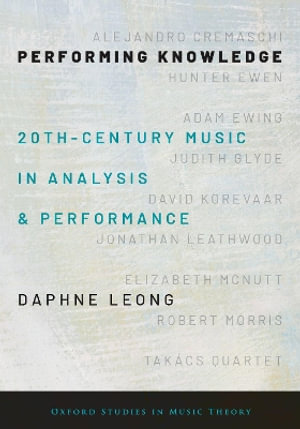
How do musical analysis and performance relate? In a unique collaborative approach to this question, theorist-pianist Daphne Leong partners with internationally renowned performers to interpret twentieth-century repertoire. Imaginative explorations of music by Ravel, Schoenberg, Bartok, Schnittke, Milhaud, Messiaen, Babbitt, Carter, and Morris illuminate focal issues such as the role of embodiment, the affordances of a score, the cultural understanding of notation, the use of metaphor, and--to round out the viewpoints of theorist and performers with those of composer and listeners--the role of structure in audience reception.
Each exploration engages deeply with musical structure, redefined to encompass the creative activity of composers, performers, analysts, and listeners. Performances, demonstrations, and interviews online complement the book's written text; practical application and pedagogical guidance round out theoretical and analytical content.
The collaborations themselves demonstrate different dimensions of knowledge at the intersection of analysis and performance, and illustrate Leong's theory of the things and people that facilitate cross-disciplinary collaboration in music. They also exemplify the antagonisms and synergies that emerge when theorists and performers meet. Both flexibly and rigorously conceived, Performing Knowledge is a brave crossing of disciplinary divides between scholarship and practice, a work of analysis shaped by the voices of performers.
Industry Reviews
"Leong's identity as a shared agent, and her longtime engagement with performance and analysis, shine through in Performing Knowledge. Three concepts [shared items, shared objectives, shared agents] provide an insightful new way of considering performance and analysis. The website includes a trove of resources ... Although this volume was not clearly intended as a textbook, it would be an interesting pedagogical experiment to use this book as a text
over the course of a semester, examining the twentieth-century musical works within and the teamwork that led to their chapters, while fostering collaborative relationships between duos and small groups of
students, leading to similar shared objects (essays, audio and video recordings) as final projects." -- Kimberly Loeffert, College Music Symposium
"A major work of scholarship .... One can well imagine that performers specializing in transitional, modern, and postmodern repertoire could benefit from experiencing its entire argument and evidence, but equally from mining it for repertoire and issues with which they are familiar, or would like to be. For a music theorist, to do the book justice, the whole probably needs to be absorbed. However it may be read, it will remain an invaluable resource. Its length
and density represent its author's wealth of musical expertise and experience, and the plurality, diversity, and cultural range of its collaborators' interactions with the author, as well as the
inherent complexity in Leong's ambition to promote intradisciplinary understanding." -- Jonathan Dunsby, Intégral 34 (2020), 51.
"Performing Knowledge is a must-read not only for professionals in the field, but for anyone interested in understanding the complexity of 20th-century music, in the importance of collaborative work, in the adventure of experimentation and in the splendor of creativity. Readers will find this book satisfying on multiple levels. Most importantly, readers will be challenged to think of collaboration and shared knowledge as keys to successful and
meaningful performance." -- Dino Mulic, American Music Teacher