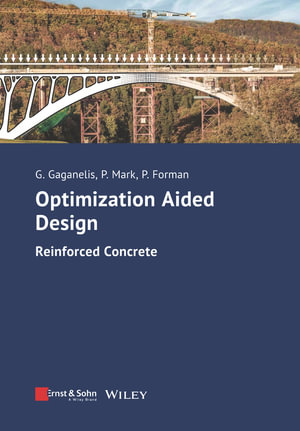
Optimization Aided Design
Reinforced Concrete
By: Georgios Gaganelis, Peter Mark, Patrick Forman
Paperback | 16 May 2022 | Edition Number 1
At a Glance
224 Pages
24.38 x 17.27 x 1.27
Paperback
RRP $180.50
$168.99
or 4 interest-free payments of $42.25 with
orShips in 10 to 15 business days
Drei Themenbereiche sind angesprochen. Erstens, die Strukturfindung, also die Frage nach der richtigen u eren Form, dass schlanke, nach dem Kraftfluss ausgerichtete Tragwerke entstehen. Baustoffgerecht sind sie weitgehend auf Druck beansprucht. Zweitens, die Bewehrungsf hrung, die sich am inneren Kraftfluss orientiert. Vorteile ergeben sich gerade f r Scheiben, volumenartige Bauteile, an Lasteinleitungsbereichen und Aussparungen. Es entstehen anschauliche, direkt in Bewehrungen umsetzbare Fachwerkmodelle. Dritter Entwicklungsschritt ist die Behandlung von Querschnitten. Sie werden in ihrer Form optimiert und in ihrer Bewehrung bemessen. Dies gilt auch f r anspruchsvolle Beanspruchungen (zweiachsige Biegung) und nahezu beliebige Formen. Eine Parametrisierung erm glicht die allgemeing ltige bertragung auf ganze Klassen von Querschnitten.
Die optimierungsgest tzten Methoden werden vertieft und anschaulich beschrieben. Sie sind universell anwendbar und unabh ngig von Normen, Betonarten und Bewehrungen. Sie gelten f r normalfeste bis zu ultrahochfesten Betonen, f r Bewehrungen aus Stahl, Carbon oder Glasfasern und f r Bewehrungsst be als auch -fasern. Zahlreiche Abbildungen und Berechnungsbeispiele verdeutlichen die Anwendung. Zudem werden praktische Umsetzungen vorgestellt, darunter ultra-leichte Stahl-Beton-Balken, schlanke Solarkollektoren aus Beton und verbesserte Bewehrungslayouts f r Tunnelschalen. Das Buch richtet sich gleicherma en an Studierende, Forscher und Praktiker.
Industry Reviews
The methods, procedures and calculations described in this book represent an important step towards a kind of building that has little to do with the way we know it today. And this is a good thing.
(Prof. Dr.-Ing. Dr.-Ing. E. h. Manfred Curbach in his foreword.)
The introduction of state-of-the-art optimization methods [to concrete design] and the resulting minimum-material component shapes, which also have a minimized need for reinforcing steel (?), promote construction with concrete that is characterized by considerable material savings and thus considerable emission savings for the same utility value and durability. Supported by clearly understandable descriptions and a large number of examples, readers will find their way around quickly and easily. This makes it much easier to understand the subject matter, which is not always simple.
This book provides a significant contribution to establishing a new foundation for building with concrete, this wonderful building material for everyone and for almost everything.
(Prof. em. Dr. Dr. E. h. Dr. h. c. Werner Sobek in his foreword.)
Foreword by Manfred Curbach v
Foreword by Werner Sobek ix
Preface xiii
List of Examples xix
Acronyms xxi
About the Authors xxiii
Acknowledgments xxv
1 Introduction 1
1.1 Preliminaries 1
1.2 Outer and Inner Shaping 2
1.3 Environmental Demands 6
1.4 Optimization Aided Design (OAD) 11
1.5 Structure of the Book 14
References 15
2 Fundamentals of Reinforced Concrete (RC) Design 19
2.1 Basic Principles 19
2.2 Verification Concept 21
2.3 Safety Concept 22
2.4 Materials 23
2.4.1 Plain Concrete 23
2.4.2 Fiber-Reinforced Concrete (FRC) 24
2.4.3 Ultra-High Performance Concrete (UHPC) 26
2.4.4 Reinforcement 27
2.5 Load-Bearing Behavior 28
2.5.1 Bending Design 28
2.5.1.1 Fundamentals 28
2.5.1.2 Equilibrium for Composite Sections 29
2.5.2 Strut-and-Tie Models (STMs) 32
References 35
3 Fundamentals of Structural Optimization 37
3.1 Structural Optimization Approaches 37
3.1.1 General Procedure 37
3.1.2 Classification of Methods 38
3.2 Problem Statement 40
3.3 Lagrange Function 43
3.4 Sensitivity Analysis 44
3.4.1 Numerical Approach 44
3.4.2 Analytical Approach 45
3.5 Solution Methods 46
3.5.1 Mathematical Programming 46
3.5.2 Optimality Conditions (OC) 47
References 47
4 Identification of Structures 51
4.1 One-material Structures 52
4.1.1 Problem Statement 52
4.1.2 Sensitivity Analysis 54
4.1.3 Filtering 54
4.1.4 Solving 56
4.1.5 Optimization Process 57
4.1.6 Multiple Load Cases 58
4.2 One-material Stress-biased Structures 59
4.2.1 Problem Statement 59
4.2.2 Sensitivity Analysis and Stress Bias 60
4.2.3 Solving 62
4.2.4 Optimization Process 63
4.3 Bi-material Structures 64
4.3.1 Problem Statement 64
4.3.2 Sensitivity Analysis and Stress Differentiation 65
4.3.3 Bi-material Filtering 68
4.3.4 Solving 69
4.3.5 Optimization Process 70
4.4 Examples 71
4.4.1 One-material Structures 71
4.4.2 One-material Stress-biased Structures 81
4.4.3 Bi-material Structures 83
4.5 Applications 89
4.5.1 Solar Thermal Collectors 89
4.5.1.1 Parabolic Trough Collectors 90
4.5.1.2 Heliostats 95
4.5.2 Ultra-light Beams 100
References 102
5 Internal Force Flow 109
5.1 Preliminaries 110
5.2 Continuum Topology Optimization (CTO) Approach 111
5.3 Truss Topology Optimization (TTO) Approach 112
5.3.1 Problem Statement 112
5.3.2 Sensitivity Analysis and Solving 117
5.3.3 Optimization Process 119
5.3.4 Recommendations for Practical Application 120
5.3.4.1 Setting Up the Optimization Problem 120
5.3.4.2 Procedure 123
5.4 Continuum-Truss Topology Optimization (CTTO) Approach 124
5.4.1 Problem Statement 125
5.4.2 Sensitivity Analysis and Solving 128
5.4.3 Post-Processing 130
5.4.4 Optimization Process 132
5.5 Examples 133
5.5.1 CTO Approach 133
5.5.2 TTO Approach 138
5.6 Applications 151
5.6.1 Joints in Tunnel Linings 151
5.6.2 Partial Area Loading in Tunnel Linings 153
References 153
6 Design of Cross-sections 157
6.1 Problem Statement 159
6.2 Equilibrium Iteration 161
6.3 Sectional Optimization 163
6.3.1 Reinforcement Amounts 165
6.3.2 Cross-sectional Layout 165
6.3.3 Material Weighting 165
6.4 Solving 166
6.4.1 Stress Integrals 166
6.4.2 Optimization Problem 167
6.5 Parameterization 167
6.5.1 Plane Case 167
6.5.2 Spatial Case 168
6.5.3 Parameterization with Intentional Steering 169
6.6 Examples 170
6.6.1 Equilibrium Iteration 170
6.6.2 Sectional Optimization 175
References 183

ISBN: 9783433033371
ISBN-10: 3433033374
Published: 16th May 2022
Format: Paperback
Language: English
Number of Pages: 224
Audience: Professional and Scholarly
Publisher: Wiley
Country of Publication: DE
Edition Number: 1
Dimensions (cm): 24.38 x 17.27 x 1.27
Weight (kg): 0.41
Shipping
| Standard Shipping | Express Shipping | |
|---|---|---|
| Metro postcodes: | $9.99 | $14.95 |
| Regional postcodes: | $9.99 | $14.95 |
| Rural postcodes: | $9.99 | $14.95 |
Orders over $79.00 qualify for free shipping.
How to return your order
At Booktopia, we offer hassle-free returns in accordance with our returns policy. If you wish to return an item, please get in touch with Booktopia Customer Care.
Additional postage charges may be applicable.
Defective items
If there is a problem with any of the items received for your order then the Booktopia Customer Care team is ready to assist you.
For more info please visit our Help Centre.
You Can Find This Book In

Basic Plumbing Skills 4e, Water Supply 4e, Sanitary and Drainage 3e, Gas Services 3e & Roof Plumbing 3e Value Pack
Cengage Plumbing Skills
Multi-Item Pack
RRP $394.95
$311.75
OFF

Reinforced Concrete Basics (Pearson Original Edition) 3ed
Analysis and Design of Reinforced Concrete Structures
Paperback
RRP $138.55
$111.99
OFF