Get Free Shipping on orders over $79
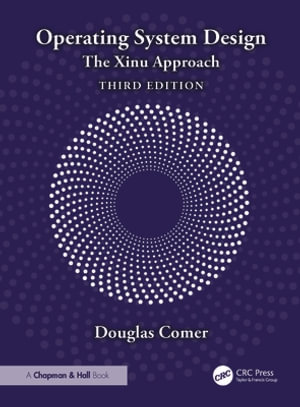
Operating System Design : The Xinu Approach - Douglas Comer

Operating System Design

The Xinu Approach

By: Douglas Comer

Hardcover | 22 May 2025 | Edition Number 3

At a Glance

Hardcover


RRP $168.00

$149.75

11%OFF

or 4 interest-free payments of $37.44 with

 or 

Available for Backorder. We will order this from our supplier however there isn't a current ETA.

Lauded for avoiding the typical vague, high-level survey approach found in many texts, earlier editions of this bestselling book removed the mystery by explaining the internal structure of an operating system in clear, readable prose. The third edition of Operating System Design: The Xinu Approach expands and extends the text to include new chapters on a pipe mechanism, multicore operating systems, and considerations of operating systems being used in unexpected ways.

The text covers all major operating system components, including the key topics of scheduling and context switching, physical and virtual memory management, file systems, device drivers, device-independent I/O, Internet communication, and user interfaces. More important, the book follows a logical architecture that places each component in a multi-level hierarchy. It simplifies learning about operating systems by allowing a reader to understand one level at a time without needing forward references. It starts with a bare machine and builds the system level by level. In the end, a reader will appreciate how all the components of an operating system work together to form a unified, integrated platform that allows arbitrary application programs to run concurrently.

The text uses a small, elegant system named Xinu as an example to illustrate the concepts and principles and make the discussion concrete. Because an operating system must deal with the underlying hardware, the text shows examples for the two basic computer architectural approaches used in the computer industry: CISC and RISC. Readers will see that most of the code remains identical across the two architectures, and they can easily compare the differences among the machine-dependent pieces, such as hardware initialization code, device interface code, and context switch code.

Xinu code is freely available, and readers are strongly encouraged to download the system and experiment by making modifications or extensions. The Xinu web page, https://xinu.cs.purdue.edu, contains links to the code from the book as well as instructions on how to run Xinu on experimenter hardware boards. The page also provides links to a version that runs on the (free) VirtualBox hypervisor. A reader can install VirtualBox on their laptop or desktop, and then run Xinu without the need for additional hardware.

Companion resources found here: https://www.cs.purdue.edu/homes/comer/downloads/private/Xinu_Book_Slides

More in Operating Systems

macOS Tahoe For Dummies : For Dummies (Computer/Tech) - Guy Hart-Davis
Microsoft Power BI Step by Step - Jose Escalante
Principles of Operating Systems - Kate Summers
Linux All-In-One For Dummies : For Dummies (Computer/Tech) - Richard Blum
The Site Reliability Workbook : Practical ways to implement SRE - Betsy Beyer
Windows 11 For Dummies, 2nd Edition : Windows 11 For Dummies - Alan Simpson
Windows 11 All-in-One For Dummies, 2nd Edition : For Dummies - Ciprian Adrian Rusen
iPad & iPad Pro for Dummies : 2024-2025 Edition - Paul McFedries

RRP $49.95

$38.75

22%
OFF
Modern Operating Systems, Global Edition : 5th Edition - Andrew Tanenbaum
Git : Pocket Guide : A Working Introduction - Richard Silverman

RRP $47.75

$26.75

44%
OFF
UNIX and Linux System Administration Handbook : 5th Edition - Ben Whaley
Rust Atomics and Locks : Low-Level Concurrency in Practice - Mara Bos
TCP/IP Network Administration 3e : O'Reilly Ser. - Craig Hunt

RRP $104.75

$51.75

51%
OFF
Ubuntu Linux Bible - David Clinton

RRP $90.95

$69.75

23%
OFF
Learning the bash Shell : In a Nutshell (O'Reilly) - Cameron Newham