

Get Free Shipping on orders over $79
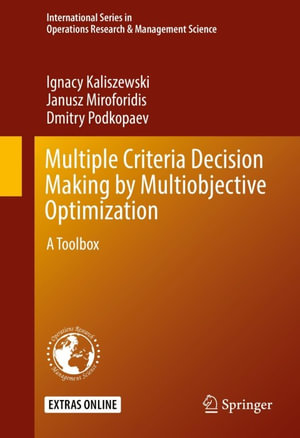
Multiple Criteria Decision Making by Multiobjective Optimization : A Toolbox - Ignacy Kaliszewski

Multiple Criteria Decision Making by Multiobjective Optimization

A Toolbox

By: Ignacy Kaliszewski, Janusz Miroforidis, Dmitry Podkopaev

eText | 2 August 2016

At a Glance

eText


$89.99

or 4 interest-free payments of $22.50 with

 or 

Instant online reading in your Booktopia eTextbook Library *

Why choose an eTextbook?

Instant Access *

Purchase and read your book immediately

Read Aloud

Listen and follow along as Bookshelf reads to you

Study Tools

Built-in study tools like highlights and more

* eTextbooks are not downloadable to your eReader or an app and can be accessed via web browsers only. You must be connected to the internet and have no technical issues with your device or browser that could prevent the eTextbook from operating.

This textbook approaches optimization from a multi-aspect, multi-criteria perspective. By using a Multiple Criteria Decision Making (MCDM) approach, it avoids the limits and oversimplifications that can come with optimization models with one criterion. The book is presented in a concise form, addressing how to solve decision problems in sequences of intelligence, modelling, choice and review phases, often iterated, to identify the most preferred decision variant. The approach taken is human-centric, with the user taking the final decision is a sole and sovereign actor in the decision making process. To ensure generality, no assumption about the Decision Maker preferences or behavior is made. The presentation of these concepts is illustrated by numerous examples, figures, and problems to be solved with the help of downloadable spreadsheets. This electronic companion contains models of problems to be solved built in Excel spreadsheet files.

Optimization models are too often oversimplifications of decision problems met in practice. For instance, modeling company performance by an optimization model in which the criterion function is short-term profit to be maximized, does not fully reflect the essence of business management. The company's managing staff is accountable not only for operational decisions, but also for actions which shall result in the company ability to generate a decent profit in the future. This calls for management decisions and actions which ensure short-term profitability, but also maintaining long-term relations with clients, introducing innovative products, financing long-term investments, etc. Each of those additional, though indispensable actions and their effects can be modeled separately, case by case, by an optimization model with a criterion function adequately selected. However, in each case the same set of constraints represents the range of company admissible actions. The aim and the scope of this textbook is to present methodologies and methods enabling modeling of such actions jointly.

on
Desktop
Tablet
Mobile

More in Operational Research

Logistics Handbook - James F. Robeson

eBOOK

Shaping Collaborative Ecosystems for Tomorrow - Igor Perko

eBOOK

Current Issues in Accounting - Niyazi Kurnaz

eBOOK

RRP $143.95

$129.99

10%
OFF
Operations Management - Steven Bragg

eBOOK