Get Free Shipping on orders over $89
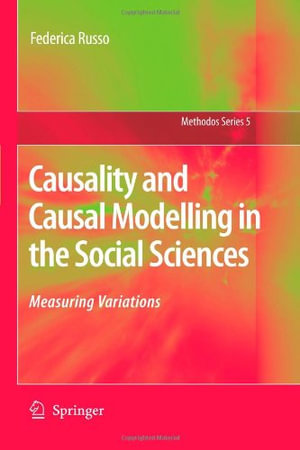
Methodos : Measuring Variations - Federica Russo

Methodos

Measuring Variations

By: Federica Russo

Paperback | 18 November 2010

At a Glance

Paperback


$219.75

or 4 interest-free payments of $54.94 with

 or 

Ships in 5 to 7 business days

Preface.- Introduction.- 1: Scope of the book and methodology.- 2: Structure of the book.- 3: Philosophical issue in the back of the mind.- 4: Philosophy at the service of social research.- 5: Open problems: causal realism, objectivity, and social ontology.- 1: What do social scientists do?.- Introduction.- 1.1: Different causal claims?.- 1.2: Smoking and lung cancer.- 1.3: Mother's education and child survival.- 1.4: Health and wealth.- 1.5: Farmer's migration.- 1.6: Job satisfaction.- 1.7: Methodological and epistemological morals.- 2: Probabilistic approaches.- Introduction.- 2.1: Philosophical accounts: Good and Suppes.- 2.2: probabilistic theories: traditional criticisms.- 2.3: Brining causal theory to maturity.- 3: Methodology of causal modeling.- Introduction.- 3.1: Methods and assumptions of causal modeling.- 3.1.1: Path models and causal diagrams.- 3.1.2: Covariance structure models.- 3.1.3: Granger-causality.- 3.1.4: Rubin's model.- 3.1.5: Multilevel analysis.- 3.1.6: Contingency tables.- 3.2: Hypothetico-deductive methodology.- 3.3: Difficulties and weaknesses of causal modeling.- 4: Epistemology of causal modeling.- Introduction.- 4.1: The rationale of causality: Measuring variations.- 4.2: Varieties of variations.- 4.3: Wha guarantees the causal interpretation?.- 4.3.1: Associational models.- 4.3.2: Causal models.- 5: Methodological consequences: objective Bayesianism.- Introduction.- 5.1: Probabilistic causal inferences.- 5.2: Interpretations of probability.- 5.3: The case for frequency-driven epistemic probabilities.- 6: Methodological consequences: mechanisms and levels of causation.- Introduction.- 6.1: Mechanisms.- 6.1.1" Modelling mechanisms.- 6.1.2: Mixed mechanisms.- 6.1.3 Explaining through mechanisms.- 6.1.4: Modelling causal mechanisms vs. modeling decision-making processes.- 6.2: Levels of causation.- 6.2.1: Twofold causality.- 6.3: Levels of analysis.- 6.3.1: Types of variables and of fallacies.- 6.3.2: Levels of analysis vs. levels of causation.- 6.3.3: Levels of analysis.- 6.3.4: Levels of analysis and variation in multilevel models.- 7: Supporting the rationale of variations.- Introduction,- 7.1: Variation in mechanist approaches.- 7.2: Variation in counterfactuals.- 7.3: Variation in agency theories.- 7.4: Variation in manipulability theories.- 7.5: Variation in epistemic causality.- 7.6: Variation in single instances: concluding remarks.- 1: Objectives, methodology, and results.- 2: The methodological import of philosophical results.- References.- Index

Industry Reviews

From the reviews:

"Few books in philosophy specifically deal with causality in the social sciences. Fewer still draw on real examples taken from the social science literature. Here is an exception to the rule. Though a philosopher, Dr. Russo has an extensive background in the social sciences and has collaborated with social scientists in several of her research projects.

Causality and Causal Modelling in the Social Sciences: Measuring Variations is therefore a compulsory reading both for philosophers of science and for social scientists. For philosophers on the one hand, reading this book is a good way of experiencing how social science is actually done, far from the arm-chair view of scientific practice. For social scientists on the other hand, it is a way of confronting their practice in causal research to broader concerns in the philosophy of science.

Strongly recommended also to the sceptics who believe that, because there are no general laws in the social sphere, causal explanations are impossible. They will think twice after reading this book."

(Prof. Guillaume Wunsch, Institute of Demography, University of Louvain, Belgium)

"In Causality and Causal Modelling in the Social Sciences, Federica Russo attempts a mutually enlightening exchange between the philosophical literature on causation and causal modeling approaches in social science. ... The coverage of the philosophical literature on causation is good ... . does a good job of providing an overview of current philosophical discussions of causation and probability, and I think it should be commended for attempting to systematically engage this philosophical literature with real social science research." (Daniel Steel, British Journal for the Philosophy of Science, Vol. 63 (3), September, 2012)

Other Editions and Formats

Hardcover

Published: 24th October 2008

More in Social Research & Statistics

English as a Lingua Franca : Practice and Research - William J. Crawford
SPSS for Psychologists - Virginia Harrison

RRP $220.00

$192.99

12%
OFF
Death of a Racehorse : An American Story - Katie Bo Lillis

RRP $39.99

$35.75

11%
OFF
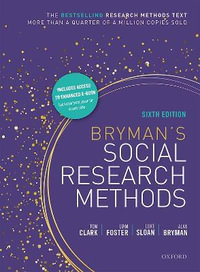
Social Research Methods : 6th edition - Alan  Bryman

RRP $102.95

$83.75

19%
OFF
Research Is Ceremony : Indigenous Research Methods - Shawn Wilson
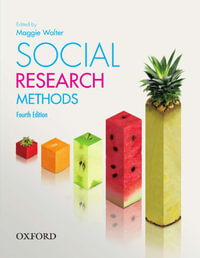
Social Research Methods : 4th Edition - Maggie Walter

RRP $101.95

$87.75

14%
OFF
The Art of Statistics : Learning from Data - David Spiegelhalter

RRP $26.99

$22.99

15%
OFF
Qualitative Data Analysis with NVivo - Jenine Beekhuyzen
Sampling : 3rd Edition - Design and Analysis - Sharon L. Lohr

RRP $162.00

$118.99

27%
OFF
Discovering Statistics Using R and RStudio - Andy Field
The Basics of Social Research : 7th Edition - Earl  Babbie

RRP $204.95

$155.75

24%
OFF
The Practice of Social Research : 15th edition - Earl R. Babbie

RRP $179.95

$137.75

23%
OFF