Get Free Shipping on orders over $79
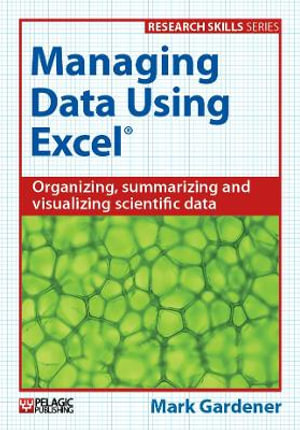
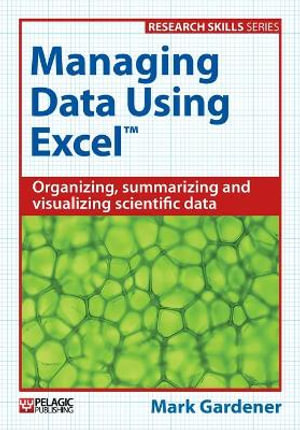
Managing Data Using Excel : Research Skills - Mark Gardener

Managing Data Using Excel

By: Mark Gardener

Paperback | 23 February 2015

At a Glance

Paperback


$49.49

or 4 interest-free payments of $12.37 with

 or 

Ships in 7 to 10 business days

Microsoft Excel is a powerful tool that can transform the way you use data. This book explains in comprehensive and user-friendly detail how to manage, make sense of, explore and share data, giving scientists at all levels the skills they need to maximize the usefulness of their data.

Readers will learn how to use Excel to:
* Build a dataset - how to handle variables and notes, rearrangements and edits to data.
* Check datasets - dealing with typographic errors, data validation and numerical
errors.
* Make sense of data - including datasets for regression and correlation; summarizing data with averages and variability; and visualizing data with graphs, pivot charts and sparklines.
* Explore regression data - finding, highlighting and visualizing correlations.
* Explore time-related data - using pivot tables, sparklines and line plots.
* Explore association data - creating and visualizing contingency tables.
* Explore differences - pivot tables and data visualizations including box-whisker plots.
* Share data - methods for exporting and sharing your datasets, summaries and
graphs.

Alongside the text, Have a Go exercises, Tips and Notes give readers practical experience and highlight important points, and helpful self-assessment exercises and summary tables can be found at the end of each chapter. Supplementary material can also be downloaded on the companion website.

Managing Data Using Excel is an essential book for all scientists and students who use data and are seeking to manage data more effectively. It is aimed at scientists at all levels but it is especially useful for university-level research, from undergraduates to postdoctoral researchers.

Industry Reviews
Managing Data Using Excel ... ... is a new book by Mark Gardener, published by Pelagic Publishing.* It is subtitled "Organising, summarising and visualising scientific data". Clearly the book is aimed at scientists, particularly those dealing with the analysis of observational data, but is it of value to a wider audience? Having worked through the book I would say that it is definitely worthwhile for many other groups, including those in engineering and other branches of science and technology, and also those in commercial and marketing work dealing with the analysis of numerical data of any kind. Aspects of the book that I found particularly useful were: Detailed and clear descriptions of the use of pivot tables in the analysis and summary of numerical data of any kind (an area where I could certainly make more use of the features available in Excel) Clearly laid out procedures for arranging, checking and exploring data. Detailed procedures for display of data in a wide variety of graphs. Detailed step-by step example spreadsheets available from the publisher's web-site. This is certainly not a book "for dummies", and some may find the emphasis on scientific procedures off-putting, but for those willing to spend some time working through the examples I believe it will be of value to anyone who uses Excel to organise, summarise and visualise numerical data of any kind. * Pelagic Publishing provided me with a free copy of the book for this review; I have no other connection with the publishers or the author. -- Doug Jenkins * Newton Excel Bach blog * Managing Data Using Excel: Organizing, Summarizing and Visualizing Scientific Data joins others in the 'Research Skills' series and is a top recommendation for any who would use their Excel spreadsheet skills to organize and share scientific data, standing out from the crowd of more general 'how to use Excel' handbooks to address the specific needs of the scientific community. There are basics here, from how to build a dataset handling variables and notes to summarizing data using averages, creating visual displays with graphs and pivot charts, and using these tables to fine-tune results and displays that export well into datasets and summaries scientists can share. Exercises are provided to reinforce concepts, while tips and notes compliment the educational process by pointing out common Excel challenges. Plenty of tables and charts pepper the discussions while an index makes it easy to use this is a reference for at-a-glance information. Plenty of general Excel handbooks document how to create datasets and apply calculations, but the specific focus on scientific data manipulation provided here makes it a top recommendation over any general tutorial. -- Diane Donovan * Midwest Book Review *

Other Editions and Formats

Hardcover

Published: 24th May 2015

More in Spreadsheet Software

Microsoft 365 Excel All-in-One For Dummies : Excel for Dummies - David H. Ringstrom
Microsoft Power BI Step by Step - Jose Escalante
Microsoft 365 Excel For Dummies : For Dummies (Computer/Tech) - David H. Ringstrom
Excel Dashboards & Reports For Dummies : 4th edition - Michael Alexander
Excel Workbook For Dummies : 2nd edition - Paul McFedries

RRP $62.46

$52.75

16%
OFF
Financial Analysis with Microsoft Excel : 9th edition - Timothy Mayes
Microsoft Power BI Dashboards Step by Step : Step by Step - Errin O'Connor
Excel 2019 All-in-One For Dummies : All-in-One For Dummies - Greg Harvey
Financial Modeling in Excel For Dummies : 2nd edition - Danielle Stein Fairhurst
Problem Solving Cases In Microsoft Access & Excel : 16th edition - Ellen Monk
Excel Data Analysis For Dummies : 5th edition - Paul McFedries

RRP $69.95

$52.75

25%
OFF
Microsoft Excel 365 Bible : Bible - Michael Alexander

RRP $90.95

$65.75

28%
OFF
Microsoft 365 Excel Formulas & Functions For Dummies : For Dummies - Ken Bluttman
Google Workspace For Dummies : For Dummies (Computer/Tech) - Paul McFedries
Microsoft Power BI Visual Calculations : Simplifying DAX - Jeroen ter Heerdt