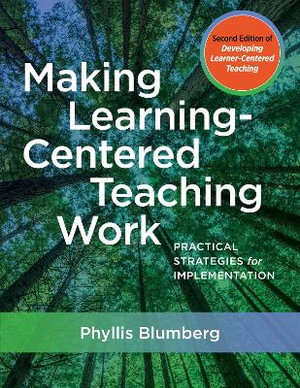
"Making Learning-Centered Teaching Work by dedicated and committed educator Phyllis Blumberg is a detailed and insightful textbook that encourages professors and educators in higher education to utilize the model of learning-centered teaching. The author promotes the use of 'backward course design' to produce meaningful course planning and active learning from students. The core of the textbook provides a practical system for changing teaching practices supported by evidence. Learning-centered teaching shifts from what an instructor is teaching to what a student is mastering.
Blumberg's writing is energetic, insightful, and easy to comprehend. Her explanations and suggestions are easy to follow and inspire a change to teaching practice. For educators, instructors, and even teachers who are interested in learning-centered teaching but do not have professional knowledge, this textbook provides great opportunities for learning.
After reading Making Learning-Centered Teaching Work, it is evident that it is possible to create opportunities for students to engage in content on a deeper level and manage their own learning. This textbook contains positive ideas and strategies to strengthen an educator's teaching practice. Blumberg helps us understand that although instructors may have effective teaching methods, there are many strategies to help improve student learning. However, if we ignore these ideas and components, our students may never know what it means to be independent learners.
Teaching is a personal profession and each professor, instructor, and educator has unique delivery methods, but all of them can benefit from learning-centered teaching and should read Making Learning-Centered Teaching Work. This is a book about teaching and learning discoveries and psychology for improvement. It will stimulate the passion for teaching and show the importance of making learning-centered teaching work."
Teachers College Record
"Phyllis Blumberg is an independent consultant who spent ten years as the director of the Teaching and Learning Center at the University of the Sciences in Philadelphia among other faculty development roles. She draws from all that experience in this workbook of learning-centered teaching, an extremely rich serving of both wisdom and strategy. Blumberg makes the complex practice of learning-centered teaching clear through careful analysis of its parts, numerous examples, and abundant guidance for assessment. She has her audience in mind and includes numerous examples from a range of disciplines, numerous opportunities for detailed self-reflection, and recommendations for a variety of ways a time-pressed instructor might choose to use this material. While providing plentiful detail, Blumberg herself recommends that faculty might begin by identifying the areas that are most important to them-whether individual, study group, or program. She even provides a chart in the preface for a range of disciplines and teaching concerns that are likely to be of particular interest so that instructors can easily locate the discussion that addresses their immediate concerns. In this way she provides relief for those instructors who might be reluctant to wrestle with such a dense volume."
The Wabash Center Journal on Teaching