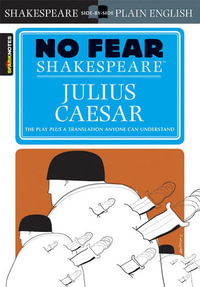
Julius Caesar
by William Shakespeare
After defeating enemies in battle, Roman citizens celebrate in the streets as Julius Caesar and his entourage make their way through the city. As Caesar passes a soothsayer, he receives an ominous warning: "Beware the ides of March," which he immediately disregards. Meanwhile, some of his closest followers are convinced their leader has become too powerful and plot his removal. Plutarch's Lives of the Noble Grecians and Romans was Shakespeare's primary source for Julius Caesar.
The Tragedy of Julius Caesar (First Folio title: The Tragedie of Ivlivs C¦sar), often shortened to Julius Caesar, is a historical tragedy by William Shakespeare, believed to have been written and first performed in 1599. The play portrays the political conspiracy that led to the assassination of the Roman dictator Julius Caesar and Rome's subsequent civil war. Drawing primarily (with deviations in various aspects) from Sir Thomas North's 1579 translation of Parallel Lives by Plutarch, Shakespeare presents a dramatised account of Caesar's growing power, his murder by a group of senators led by Cassius and Brutus, and the defeat of the conspirators by the forces of Mark Antony and Octavius at the Battle of Philippi.
Although named after Caesar, the play focuses largely on Brutus, whose moral and political dilemmas have often led critics to regard him as its tragic hero. Central themes include the tension between personal loyalty and public duty, the use of rhetoric in politics, and the fragility of republican governance in the face of ambition and power. Julius Caesar was among the first plays performed at the Globe Theatre and has remained one of Shakespeare's most frequently staged works. It has been adapted in numerous forms and interpreted in diverse political contexts, reflecting concerns from Elizabethan debates on succession to modern discussions of dictatorship and democracy. The play is widely studied for its exploration of character, persuasion, and political morality, and it continues to influence literature, theater, and political discourse.
Synopsis
The play opens with two tribunes Flavius and Marullus (appointed leaders/officials of Rome) discovering the commoners of Rome celebrating Julius Caesar's triumphant return from defeating the sons of his military rival, Pompey. The tribunes, insulting the crowd for their change in loyalty from Pompey to Caesar, attempt to end the festivities and break up the commoners, who return the insults. During the feast of Lupercal, Caesar holds a victory parade and a soothsayer warns him to "Beware the ides of March," which he ignores. Meanwhile, Cassius attempts to convince Brutus to join his conspiracy to kill Caesar. Although Brutus, friendly towards Caesar, is hesitant to kill him, he agrees that Caesar may be abusing his power. They then hear from Casca that Mark Antony has offered Caesar the crown of Rome three times. Casca tells them that each time Caesar refused it with increasing reluctance, hoping that the crowd watching would insist that he accept the crown. He describes how the crowd applauded Caesar for denying the crown, and how this upset Caesar. On the eve of the ides of March, the conspirators meet and reveal that they have forged letters of support from the Roman people to tempt Brutus into joining. Brutus reads the letters and, after much moral debate, decides to join the conspiracy, thinking that Caesar should be killed to prevent him from doing anything against the people of Rome if he were ever to be crowned.







![Romeo & Juliet [Super Readable Edition] : Dyslexia-friendly Plays - William Shakespeare](https://www.booktopia.com.au/covers/200/9780008750329/7073/romeo-juliet-super-readable-edition-.jpg)