


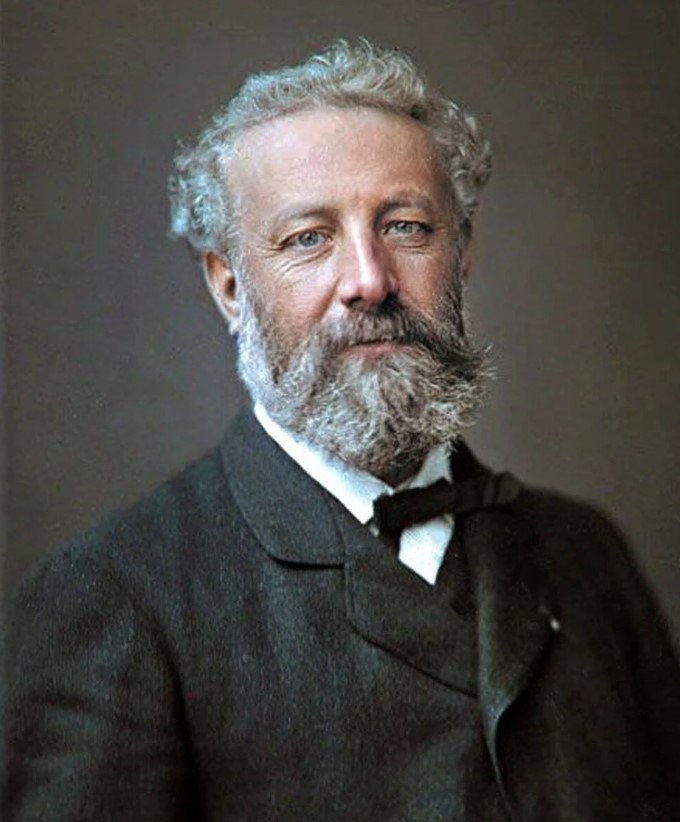
Jules Verne
"We are of opinion that instead of letting books grow moldy behind an iron grating, far from the vulgar gaze, it is better to let them wear out by being read."
Jules Verne is an internationally renowned French writer, known for his novels, poems, and plays. He is most well known for his series ‘Voyages Extraordinaires’, which include Journey to the Centre of the Earth, 20,000 Leagues Under the Sea, and Around the World in Eighty Days.
These novels are not just fun adventure stories, but exciting tales about the potential of the cutting edge technology of the latter half of the 19th century. They captured the imagination of readers of the day, and cemented him as one of the original fathers of science fiction.
Meet Jules Verne
Jules Verne was born in February 1828 in modern-day Nantes, France. He was sent to boarding school at a young age, where he met his teacher Madame Sambin, whose naval captain husband had disappeared several decades earlier. Her insistence to her students that her husband would one day reappear helped to influence several of Verne’s later stories, including The Mysterious Island.
Verne began writing seriously at just 19, even though his father was adamant that Jules give up the hobby and take over the family law practice. Verne was therefore sent to Paris to study law, where he continued his side passion for writing, namely putting together plays. At the time, he was greatly influenced by Victor Hugo and could recite pages of his work.
Even though Verne graduated with his law degree, his continued to write, eventually making friends with Alexandre Dumas and working together on plays. Around this time, he also began writing for a magazine. Yet it wasn’t until his father offered him a law practice that Verne made the decision to turn down the job and take up writing as a full-time career.
In 1862, he met a man who agreed to publish his science fiction works. One of the first was ‘Five Weeks in a Balloon’, which was an international success and the start of an extremely successful collaboration between author and publisher, that would go on to last many decades.
Today, Jules Verne is the second most translated author in the world (second only to Agatha Christie). His work greatly influenced other writers and the science fiction genre, and has been adapted for television and film.
What genres and styles did Jules Verne write in?
Verne is best known for adventure fiction and early science fiction, combining travel and exploration with the cutting-edge technology and scientific ideas of the 19th century.
Which Jules Verne books are most famous and where should I start?
His best-known novels include Journey to the Centre of the Earth, 20,000 Leagues Under the Sea, and Around the World in Eighty Days. For a first read, Around the World in Eighty Days is a light, fast-paced choice; 20,000 Leagues Under the Sea showcases his maritime imagination; Journey to the Centre of the Earth is a classic speculative adventure.
What is the Voyages Extraordinaires series and do I need to read it in order?
Voyages Extraordinaires is the collective name for Verne's adventure and science fiction novels. Most titles stand alone, so you do not need to read them in series order; you can read by personal interest or follow original publication order if you prefer a historical progression.
What recurring themes and technologies appear in Verne's work?
Common themes include exploration, scientific curiosity, travel and human ingenuity. Verne frequently features contemporary technologies of his era such as balloons, submarines, advanced ships and geological exploration, imagining their adventurous potential.
Have Jules Verne's works been adapted or influenced other writers?
Yes. Verne's novels have been widely adapted for film and television and have had a major influence on later science fiction writers and the development of the genre. He is also one of the most translated authors worldwide.