Get Free Shipping on orders over $79
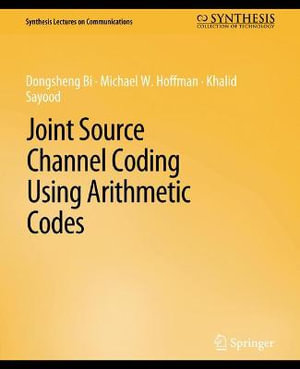
Joint Source Channel Coding Using Arithmetic Codes : Synthesis Lectures on Communications - Bi Dongsheng

Joint Source Channel Coding Using Arithmetic Codes

By: Bi Dongsheng, Michael Hoffman, Khalid Sayood

Paperback | 6 November 2009

At a Glance

Paperback


$44.99

or 4 interest-free payments of $11.25 with

 or 

Ships in 5 to 7 business days

Based on the encoding process, arithmetic codes can be viewed as tree codes and current proposals for decoding arithmetic codes with forbidden symbols belong to sequential decoding algorithms and their variants. In this monograph, we propose a new way of looking at arithmetic codes with forbidden symbols. If a limit is imposed on the maximum value of a key parameter in the encoder, this modified arithmetic encoder can also be modeled as a finite state machine and the code generated can be treated as a variable-length trellis code. The number of states used can be reduced and techniques used for decoding convolutional codes, such as the list Viterbi decoding algorithm, can be applied directly on the trellis. The finite state machine interpretation can be easily migrated to Markov source case. We can encode Markov sources without considering the conditional probabilities, while using the list Viterbi decoding algorithm which utilizes the conditional probabilities. We can also use context-based arithmetic coding to exploit the conditional probabilities of the Markov source and apply a finite state machine interpretation to this problem.

The finite state machine interpretation also allows us to more systematically understand arithmetic codes with forbidden symbols. It allows us to find the partial distance spectrum of arithmetic codes with forbidden symbols. We also propose arithmetic codes with memories which use high memory but low implementation precision arithmetic codes. The low implementation precision results in a state machine with less complexity. The introduced input memories allow us to switch the probability functions used for arithmetic coding. Combining these two methods give us a huge parameter space of the arithmetic codes with forbidden symbols. Hence we can choose codes with better distance properties while maintaining the encoding efficiency and decoding complexity. A construction and search method is proposed and simulation results show that we can achieve a similar performance as turbo codes when we apply this approach to rate 2/3 arithmetic codes.

Table of Contents: Introduction / Arithmetic Codes / Arithmetic Codes with Forbidden Symbols / Distance Property and Code Construction / Conclusion

More in Electrical Engineering

Electrical Principles : 5th Edition - Peter Phillips

RRP $124.95

$104.75

16%
OFF
Electrical Wiring Practice : 9th Edition - Keith Pethebridge

Not Supplied By Publisher

RRP $164.95

$151.75

Digital Electronics : A Modern Approach - Rachell Hawkins
Electrical Trade Practices : 3rd Edition - Ralph Berry

RRP $124.95

$104.75

16%
OFF
Electronics All-in-One For Dummies : 3rd Edition - Doug Lowe

RRP $69.95

$52.75

25%
OFF
Bird's Engineering Mathematics : 9th Edition - John  Bird

RRP $103.00

$79.75

23%
OFF
Electrical Trade Principles : 6th Edition - Jeffrey Hampson

RRP $134.95

$112.75

16%
OFF
Electrical Principles for Electrical Trades : 8th Edition - J. Jenneson

RRP $144.95

$134.75

Fundamentals of Applied Electromagnetics : 8th Edition - Fawwaz Ulaby
Electrical Principles for the Electrical Trades + Connect + LearnSmart : 7th Edition - Jim R. Jenneson
Biosignal and Medical Image Processing : 3rd Edition - Benjamin Griffel

RRP $305.00

$216.75

29%
OFF
Principles and Applications of Electrical Engineering : 7th Edition - Giorgio Rizzoni