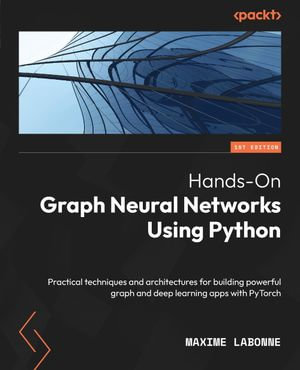
Build previously impossible applications using graph data and become an expert in graph neural networks
Key Features
- Learn the fundamentals of graph theory for data science and machine learning
- Implement state-of-the-art graph neural network architectures
- Build creative and powerful applications in various fields
Book Description
Only ten years after their creation, graph neural networks have become one of the most interesting architectures in deep learning. They have revolutionized multi-billion-dollar industries like drug discovery, where they predicted a brand-new antibiotic named Halicin. Tech companies are now trying to apply them everywhere: recommender systems for food, videos, and romantic partners; fake news detection, chip design, and 3D reconstruction.
In Graph Neural Networks, we will explore the fundamentals of graph theory and create our own datasets from raw or tabular data. We will introduce major graph neural network architectures to understand crucial concepts like graph convolution and self-attention. This knowledge will then be applied to understand and implement more specialized models, designed for various tasks (including link prediction and graph classification) or contexts (spatio-temporal data, heterogeneous graphs, and so on). Finally, we will solve real-life problems using this technology and start building a professional portfolio.
By the end of this book, you will become a Graph Neural Network expert. You will be able to reframe your problems to leverage the unreasonable effectiveness of this architecture. With these skills, you will create unique solutions using novel, state-of-the-art approaches.
What you will learn
- Create your own graph datasets from tabular or raw data
- Transform nodes and edges into high-quality embeddings
- Implement graph neural networks using PyTorch Geometric
- Select the best graph neural network model according to your problem
- Perform tasks like node classification, graph generation, link prediction
- Apply this knowledge to real use cases with raw data
Who This Book Is For
If you're interested in machine learning, Graph Neural Networks will unlock a whole range of applications that were previously impossible. Students, data scientists, and machine learning and deep learning experts will find clear and illustrated explanations with code and notebooks to get a head start. With minimal knowledge of Python and linear algebra, you will acquire highly valuable expertise in one of the most popular architectures in AI.
Table of Contents
- Getting Started with Graph Learning
- Graph Theory for Graph Neural Networks
- Creating Node Representations with DeepWalk
- Node2Vec
- Vanilla Neural Network
- Normalizing Features with Graph Convolutional Networks
- Graph Attention Network
- Scaling Graph Neural Networks
- Graph Classification
- Link Prediction
- Graph Generation
- Learning from Heterogeneous Graphs
- Temporal Graph Neural Networks
- Explainability
- Traffic Forecasting
- Anomaly Detection
- Recommender Systems