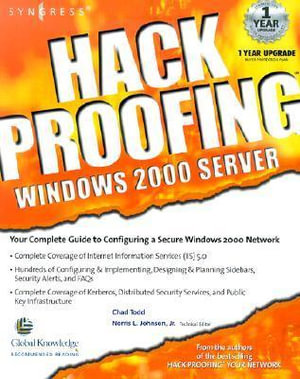
| The Windows 2000 Server Security Migration Path | p. 1 |
| Introduction | p. 2 |
| Windows 2000 Server Security | p. 3 |
| Why the Change? | p. 3 |
| Differences in Windows 2000 Server Security | p. 4 |
| Authentication Limitations | p. 7 |
| What Is the Same in Windows 2000 Server? | p. 9 |
| Upgrading and Migrating Considerations | p. 9 |
| How to Begin the Process | p. 11 |
| Getting Started | p. 12 |
| Proper Analysis | p. 16 |
| Default Access Control Settings | p. 21 |
| Introduction | p. 22 |
| The Administrators Group | p. 23 |
| The Users Group | p. 24 |
| The Power Users Group | p. 24 |
| Configuring Security during Windows 2000 Setup | p. 25 |
| Default File System and Registry Permissions | p. 30 |
| Default User Rights | p. 46 |
| Default Group Membership | p. 55 |
| Pre-Windows 2000 Security | p. 57 |
| Kerberos Server Authentication | p. 63 |
| Introduction | p. 64 |
| Authentication in Windows 2000 | p. 64 |
| Benefits of Kerberos Authentication | p. 66 |
| Standards for Kerberos Authentication | p. 66 |
| Extensions to the Kerberos Protocol | p. 67 |
| Overview of the Kerberos Protocol | p. 67 |
| Basic Concepts | p. 67 |
| Subprotocols | p. 73 |
| Tickets | p. 78 |
| Kerberos and Windows 2000 | p. 82 |
| Key Distribution Center | p. 84 |
| Kerberos Policy | p. 86 |
| Contents of a Microsoft Kerberos Ticket | p. 88 |
| Delegation of Authentication | p. 88 |
| Preauthentication | p. 89 |
| Security Support Providers | p. 89 |
| Credentials Cache | p. 90 |
| DNS Name Resolution | p. 90 |
| UDP and TCP Ports | p. 91 |
| Authorization Data | p. 92 |
| KDC and Authorization Data | p. 92 |
| Services and Authorization Data | p. 92 |
| Kerberos Tools | p. 92 |
| Kerberos List | p. 93 |
| Kerberos Tray | p. 96 |
| Secure Networking Using Windows 2000 Distributed Security Services | p. 105 |
| Introduction | p. 106 |
| The Way We Were: Security in NT | p. 106 |
| A Whole New World: Distributed Security in Windows 2000 | p. 106 |
| Windows 2000 Distributed Security Services | p. 109 |
| Active Directory and Security | p. 110 |
| Advantages of Active Directory Account Management | p. 111 |
| Relationship between Directory and Security Services | p. 119 |
| Security Protocols | p. 134 |
| NTLM Credentials | p. 134 |
| Kerberos Credentials | p. 135 |
| Private and Public Key Pairs and Certificates | p. 137 |
| Other Supported Protocols | p. 137 |
| Internet Single Sign-On | p. 138 |
| Internet Security for Windows 2000 | p. 139 |
| Client Authentication with SSL 3.0 | p. 140 |
| Authentication of External Users | p. 140 |
| Microsoft Certificate Server | p. 140 |
| CryptoAPI | p. 141 |
| Interbusiness Access: Distributed Partnership | p. 141 |
| Security Configuration Tool Set | p. 149 |
| Introduction | p. 150 |
| Security Configuration Tool Set | p. 150 |
| Security Configuration Tool Set Components | p. 151 |
| Security Configurations | p. 154 |
| Security Configuration and Analysis Database | p. 154 |
| Security Configuration and Analysis Areas | p. 156 |
| Security Configuration Tool Set User Interfaces | p. 159 |
| Configuring Security | p. 165 |
| Account Policies | p. 165 |
| Local Policies | p. 168 |
| Event Log | p. 174 |
| Restricted Groups | p. 176 |
| Registry Security | p. 179 |
| File System Security | p. 181 |
| System Services Security | p. 184 |
| Analyzing Security | p. 186 |
| Account and Local Policies | p. 188 |
| Restricted Group Management | p. 188 |
| Registry Security | p. 188 |
| File System Security | p. 189 |
| System Services Security | p. 190 |
| Group Policy Integration | p. 191 |
| Security Configuration in Group Policy Objects | p. 191 |
| Additional Security Policies | p. 193 |
| Encrypting the File System for Windows 2000 | p. 199 |
| Introduction | p. 200 |
| Using the Encrypting File System | p. 201 |
| Encryption Fundamentals | p. 201 |
| How EFS Works | p. 203 |
| User Operations | p. 204 |
| File Encryption | p. 205 |
| Assessing an Encrypted File | p. 207 |
| Copying an Encrypted File | p. 208 |
| Moving or Renaming an Encrypted File | p. 209 |
| Decrypting a File | p. 210 |
| Cipher Utility | p. 211 |
| Directory Encryption | p. 212 |
| Recovery Operations | p. 213 |
| EFS Architecture | p. 221 |
| EFS Components | p. 222 |
| The Encryption Process | p. 224 |
| The EFS File Information | p. 227 |
| The Decryption Process | p. 229 |
| IP Security for Microsoft Windows 2000 Server | p. 239 |
| Introduction | p. 240 |
| Network Encroachment Methodologies | p. 240 |
| Snooping | p. 241 |
| Spoofing | p. 241 |
| Password Compromise | p. 242 |
| Denial-of-Service Attacks | p. 242 |
| Man-in-the-Middle Attacks | p. 244 |
| Application-Directed Attacks | p. 245 |
| Compromised Key Attacks | p. 245 |
| IPSec Architecture | p. 246 |
| Overview of IPSec Cryptographic Services | p. 247 |
| IPSec Security Services | p. 252 |
| Security Associations and IPSec Key Management Procedures | p. 254 |
| Deploying Windows IP Security | p. 256 |
| Evaluating Information | p. 256 |
| Determining Required Security Levels | p. 258 |
| Building Security Policies with Customized IPSec Consoles | p. 259 |
| Flexible Security Policies | p. 261 |
| Flexible Negotiation Policies | p. 267 |
| Filters | p. 268 |
| Creating a Security Policy | p. 269 |
| Smart Cards | p. 289 |
| Introduction | p. 290 |
| Interoperability | p. 291 |
| ISO 7816, EMV, and GSM | p. 291 |
| The PC/SC Workgroup | p. 292 |
| The Microsoft Approach | p. 292 |
| Smart Card Base Components | p. 296 |
| Service Providers | p. 296 |
| Enhanced Solutions | p. 302 |
| Client Authentication | p. 302 |
| Public Key Interactive Logon | p. 302 |
| Secure E-Mail | p. 309 |
| Microsoft Windows 2000 Public Key Infrastructure | p. 315 |
| Introduction | p. 316 |
| Concepts | p. 316 |
| Public Key Cryptography | p. 317 |
| Public Key Functionality | p. 319 |
| Protecting and Trusting Cryptographic Keys | p. 323 |
| Windows 2000 PKI Components | p. 328 |
| Certificate Authorities | p. 329 |
| Certificate Hierarchies | p. 330 |
| Deploying an Enterprise CA | p. 331 |
| Trust in Multiple CA Hierarchies | p. 332 |
| Installing a Windows 2000 PKI | p. 333 |
| Enabling Domain Clients | p. 338 |
| Generating Keys | p. 338 |
| Key Recovery | p. 338 |
| Certificate Enrollment | p. 343 |
| Renewal | p. 352 |
| Using Keys and Certificates | p. 352 |
| Roaming | p. 353 |
| Revocation | p. 354 |
| Trust | p. 356 |
| Public Key Security Policy in Windows 2000 | p. 361 |
| Trusted CA Roots | p. 361 |
| Certificate Enrollment and Renewal | p. 366 |
| Smart Card Logon | p. 369 |
| Applications Overview | p. 369 |
| Web Security | p. 370 |
| Secure E-Mail | p. 370 |
| Digitally Signed Content | p. 371 |
| Encrypting File System | p. 373 |
| Smart-Card Logon | p. 373 |
| IP Security | p. 374 |
| Preparing for Windows 2000 PKI | p. 375 |
| Backing Up and Restoring Certificate Services | p. 377 |
| Supporting Non-Windows 2000 Clients and Servers | p. 393 |
| Introduction | p. 394 |
| Authenticating Down-Level Clients | p. 394 |
| Defining Lan Manager and NT Lan Manager Authentication | p. 395 |
| Using the Directory Services Client | p. 396 |
| Deploying NTLM Version 2 | p. 397 |
| Working with UNIX Clients | p. 402 |
| Installing Services for UNIX | p. 403 |
| NFS Software | p. 418 |
| Working with Novell Clients | p. 439 |
| Client Services for NetWare | p. 441 |
| Gateway Services for NetWare | p. 441 |
| Understanding Services for NetWare | p. 447 |
| Working with Macintosh Clients | p. 462 |
| Understanding Files Services for Macintosh | p. 462 |
| Understanding Print Services for Macintosh | p. 463 |
| Installing File and Print Services for Macintosh | p. 463 |
| Authenticating Macintosh Clients | p. 464 |
| Securing Internet Information Services 5.0 | p. 471 |
| Introduction | p. 472 |
| Securing the Windows 2000 Server | p. 473 |
| Installing Internet Information Services 5.0 | p. 475 |
| Securing Internet Information Services 5.0 | p. 481 |
| Setting Web Site, FTP Site, and Folder Permissions | p. 481 |
| Restricting Access through IP Address and Domain Name Blocking | p. 495 |
| Configuring Authentication | p. 497 |
| Examining the IIS Security Tools | p. 511 |
| Using the Hotfix Checking Tool for IIS 5.0 | p. 511 |
| Using the IIS Security Planning Tool | p. 513 |
| Using the Windows 2000 Internet Server Security Configuration Tool for IIS 5.0 | p. 514 |
| Auditing IIS | p. 526 |
| Using Security-Related Tools | p. 535 |
| Introduction | p. 536 |
| Installing the Support Tools | p. 536 |
| Installing the Windows 2000 Server Resource Kit | p. 540 |
| Using Application Tools | p. 544 |
| Using the Application Security Tool | p. 545 |
| Running the Applications as Services Utility | p. 546 |
| Using Service Tools | p. 556 |
| Running the Service Controller Tool | p. 556 |
| Using ScList | p. 558 |
| Using the Service Monitoring Tool | p. 561 |
| Using Registry Tools | p. 564 |
| Using Registry Backup | p. 564 |
| Using Registry Restoration | p. 565 |
| Running the Registry Console Tool | p. 566 |
| Using Process Tools | p. 569 |
| Running the Process Viewer | p. 570 |
| Running the Task List Viewer | p. 571 |
| Using the Task Killing Utility | p. 573 |
| Using Process Tree | p. 573 |
| Using PuList | p. 579 |
| Using Logging Tools | p. 581 |
| Using the Event Log Query Tool | p. 582 |
| Using Trace Logging | p. 582 |
| Using Trace Dump | p. 585 |
| Using Reduce Trace Data | p. 587 |
| Using Permission Tools | p. 588 |
| Using the Service ACL Editor | p. 589 |
| Using Permcopy | p. 590 |
| Running Access Control List Diagnostics | p. 590 |
| Running DsAcls | p. 591 |
| Using Group Management Tools | p. 593 |
| Show Groups | p. 594 |
| Using Show Members | p. 594 |
| Using Find Group | p. 595 |
| Using Miscellaneous Tools | p. 595 |
| Using Show Privilege | p. 595 |
| Running Uptime | p. 597 |
| Using Floppy Lock | p. 601 |
| Running System Scanner | p. 602 |
| A Port Numbers | p. 617 |
| Index | p. 653 |
| Table of Contents provided by Syndetics. All Rights Reserved. |