

Get Free Shipping on orders over $79
Graph Representation Learning - William L. Hamilton

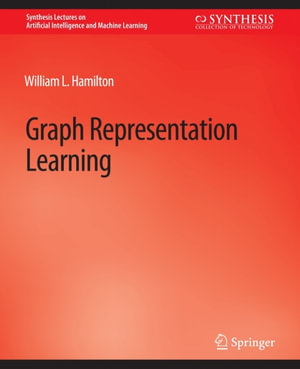
Graph Representation Learning

By: William L. Hamilton

eText | 1 June 2022

At a Glance

eText


$89.99

or 4 interest-free payments of $22.50 with

 or 

Instant online reading in your Booktopia eTextbook Library *

Why choose an eTextbook?

Instant Access *

Purchase and read your book immediately

Read Aloud

Listen and follow along as Bookshelf reads to you

Study Tools

Built-in study tools like highlights and more

* eTextbooks are not downloadable to your eReader or an app and can be accessed via web browsers only. You must be connected to the internet and have no technical issues with your device or browser that could prevent the eTextbook from operating.
Graph-structured data is ubiquitous throughout the natural and social sciences, from telecommunication networks to quantum chemistry. Building relational inductive biases into deep learning architectures is crucial for creating systems that can learn, reason, and generalize from this kind of data. Recent years have seen a surge in research on graph representation learning, including techniques for deep graph embeddings, generalizations of convolutional neural networks to graph-structured data, and neural message-passing approaches inspired by belief propagation. These advances in graph representation learning have led to new state-of-the-art results in numerous domains, including chemical synthesis, 3D vision, recommender systems, question answering, and social network analysis. This book provides a synthesis and overview of graph representation learning. It begins with a discussion of the goals of graph representation learning as well as key methodological foundations in graph theory and network analysis. Following this, the book introduces and reviews methods for learning node embeddings, including random-walk-based methods and applications to knowledge graphs. It then provides a technical synthesis and introduction to the highly successful graph neural network (GNN) formalism, which has become a dominant and fast-growing paradigm for deep learning with graph data. The book concludes with a synthesis of recent advancements in deep generative models for graphs—a nascent but quickly growing subset of graph representation learning.
on
Desktop
Tablet
Mobile

More in Artificial Intelligence

AI-Powered Search - Trey Grainger

eBOOK

HBR Guide to Generative AI for Managers : HBR Guide - Elisa Farri

eBOOK

AI : The End of Human Race - Alex Wood

eBOOK