Get Free Shipping on orders over $79
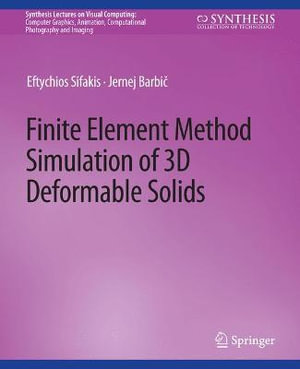
Finite Element Method Simulation of 3D Deformable Solids : Synthesis Lectures on Visual Computing: Computer Graphics, Animation, Computational Photography and Imaging - Eftychios Sifakis

Finite Element Method Simulation of 3D Deformable Solids

By: Eftychios Sifakis, Jernej Barbic

Paperback | 28 October 2015

At a Glance

Paperback


$44.99

or 4 interest-free payments of $11.25 with

 or 

Ships in 5 to 7 business days

This book serves as a practical guide to simulation of 3D deformable solids using the Finite Element Method (FEM). It reviews a number of topics related to the theory and implementation of FEM approaches: measures of deformation, constitutive laws of nonlinear materials, tetrahedral discretizations, and model reduction techniques for real-time simulation. Simulations of deformable solids are important in many applications in computer graphics, including film special effects, computer games, and virtual surgery. The Finite Element Method has become a popular tool in many such applications. Variants of FEM catering to both offline and real-time simulation have had a mature presence in computer graphics literature. This book is designed for readers familiar with numerical simulation in computer graphics, who would like to obtain a cohesive picture of the various FEM simulation methods available, their strengths and weaknesses, and their applicability in various simulation scenarios. The book is also a practical implementation guide for the visual effects developer, offering a lean yet adequate synopsis of the underlying mathematical theory. Chapter 1 introduces the quantitative descriptions used to capture the deformation of elastic solids, the concept of strain energy, and discusses how force and stress result as a response to deformation. Chapter 2 reviews a number of constitutive models, i.e., analytical laws linking deformation to the resulting force that has successfully been used in various graphics-oriented simulation tasks. Chapter 3 summarizes how deformation and force can be computed discretely on a tetrahedral mesh, and how an implicit integrator can be structured around this discretization. Finally, chapter 4 presents the state of the art in model reduction techniques for real-time FEM solid simulation and discusses which techniques are suitable for which applications. Topics discussed in this chapter include linear modal analysis, modal warping, subspace simulation, and domain decomposition.

More in Mathematics

Primary Mathematics : 4th Edition - Integrating Theory with Practice - Penelope Baker
Speed : How it Explains the World - Vaclav Smil

RRP $36.99

$29.75

20%
OFF
The Infinite Game : From the bestselling author of Start With Why - Simon Sinek
How to Win At Chess : The Ultimate Guide for Beginners and Beyond - Levy Rozman
Collins Classics - The Republic : Collins Classics - Plato
The Art of Gathering : How We Meet and Why It Matters - Priya Parker
The Maths Book : Big Ideas Simply Explained - DK

RRP $42.99

$32.99

23%
OFF
The Selfish Gene : 40th Anniversary Edition - Richard Dawkins

RRP $32.95

$26.99

18%
OFF
The Mending of Broken Bones : A Modern Guide to Classical Algebra - Paul Lockhart
Geometry : Grades 6 - 8 - Kumon Publishing

RRP $24.99

$18.75

25%
OFF
Grade 3 Geometry and Measurement - KUMON PUBLISHING

RRP $16.99

$13.75

19%
OFF
Algebra Workbook Grades 6-8 : Algebra - Kumon
Intro to Geometry : Grades 6 - 8 - Kumon Publishing

RRP $24.99

$18.99

24%
OFF
Woo's Wonderful World of Maths - Eddie Woo

RRP $29.99

$24.99

17%
OFF