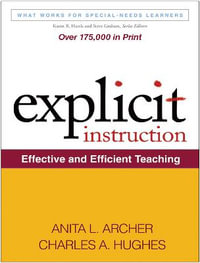
| Preface | p. xi |
| Getting Ready to Use Explicit Instruction | p. 1 |
| What Is Explicit Instruction? | p. 3 |
| Direct Instruction (D.I.) Versus Direct Instruction (d.i.) | p. 5 |
| D.I. | p. 5 |
| d.i. | p. 6 |
| Explicit Instruction: A Meaningful Alternative | p. 8 |
| Plan of the Book | p. 12 |
| Summary | p. 13 |
| Who Needs Explicit Instruction? | p. 15 |
| Understanding Your Students | p. 17 |
| What Does This Student Need? The Role of Assessment in e.i. | p. 19 |
| Monitoring Student Progress | p. 20 |
| Large-Scale Assessment | p. 20 |
| Curriculum-Based Assessment | p. 21 |
| Classroom Assessment | p. 22 |
| Assessment and e.i.: How Do They Fit Together? | p. 22 |
| Case Example: Julia | p. 23 |
| Planning for e.i. | p. 25 |
| Writing Correctly Worded Learning Objectives | p. 25 |
| Lesson Planning for e.i. | p. 28 |
| Summary | p. 28 |
| The Engaging Teacher: Dispelling the Boring Myth | p. 29 |
| Dispelling the Boring Myth | p. 29 |
| Teacher Presentation Variables | p. 30 |
| Teacher Clarity | p. 30 |
| Appropriate Rate of Presentation | p. 32 |
| Teacher Enthusiasm | p. 33 |
| Case Example: Melinda | p. 34 |
| Summary | p. 36 |
| The Active Learner: Dispelling the Passive Myth | p. 37 |
| Dispelling the Passive Myth | p. 38 |
| What Is Active Engagement? | p. 38 |
| Student Engagement Variables | p. 39 |
| Active Participation | p. 39 |
| Procedural Prompts | p. 42 |
| Monitoring Student Understanding | p. 43 |
| Summary | p. 46 |
| The Explicit Instruction Framework | p. 47 |
| Preinstructional Set | p. 49 |
| What Is Preinstructional Set? | p. 49 |
| Gain Students' Attention | p. 50 |
| Inform Students of the Learning Objective | p. 54 |
| Use Informed Instruction | p. 56 |
| Summary | p. 58 |
| Review | p. 58 |
| Apply | p. 59 |
| Preparing the Knowledge Base for Instruction | p. 61 |
| Activate Prior Knowledge | p. 62 |
| Review Previously Learned Skills | p. 64 |
| Preteach Key Vocabulary | p. 66 |
| Summary | p. 67 |
| Review | p. 68 |
| Apply | p. 68 |
| Instruction | p. 69 |
| Cognitive Modeling | p. 69 |
| Guided and Independent Practice | p. 73 |
| Closure | p. 76 |
| Summary | p. 78 |
| Review | p. 79 |
| Apply | p. 79 |
| Applications of Explicit Instruction | p. 81 |
| Explicit Instruction in Literacy | p. 83 |
| The Importance of e.i. in Reading | p. 83 |
| e.i. and Phonemic Awareness | p. 86 |
| e.i. and Phonics | p. 87 |
| e.i. and Vocabulary | p. 92 |
| e.i. and Fluency | p. 95 |
| e.i. and Reading Comprehension | p. 96 |
| e.i. and Written Expression | p. 98 |
| e.i. and Handwriting | p. 102 |
| e.i. and Spelling | p. 103 |
| e.i. and Composition | p. 104 |
| Summary | p. 105 |
| Explicit Instruction in the Content Areas | p. 107 |
| e.i. and Mathematics | p. 107 |
| e.i. in the Content Areas | p. 112 |
| e.i. and Study Skills | p. 113 |
| e.i. and Learning Strategies | p. 115 |
| Summary | p. 116 |
| Conclusions | p. 116 |
| References | p. 117 |
| Explicit Instruction Lesson Plan Format | p. 125 |
| Weekly Block Plans for Explicit Instruction | p. 127 |
| Explicit Instruction Checklist | p. 129 |
| Index | p. 131 |
| Table of Contents provided by Ingram. All Rights Reserved. |