A recent poll revealed that one in four Americans believe in both creationism and evolution, while another 41% believe that creationism is true and evolution is false. A minority (only 13%) believe only in evolution. Given the widespread resistance to the idea that humans and other animals have evolved and given the attention to the ongoing debate of what should be taught in public schools, issues related to the teaching and learning of evolution are quite timely.
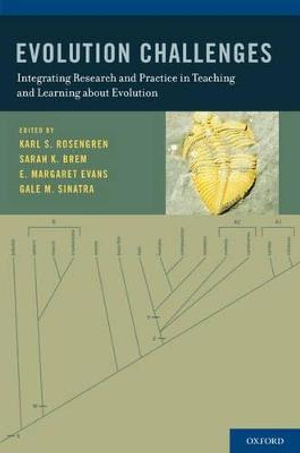
Evolution Challenges: Integrating Research and Practice in Teaching and Learning about Evolution goes beyond the science versus religion dispute to ask why evolution is so often rejected as a legitimate scientific fact, focusing on a wide range of cognitive, socio-cultural, and motivational factors that make concepts such as evolution difficult to grasp. The volume brings together researchers with diverse backgrounds in cognitive development and education to examine children's and adults' thinking, learning, and motivation, and how aspects of representational and symbolic knowledge influence learning about evolution. The book is organized around three main challenges inherent in teaching and learning evolutionary concepts: folk theories and conceptual biases, motivational and epistemological biases, and educational aspects in both formal and informal settings. Commentaries across the three main themes tie the book together thematically, and contributors provide ideas for future
research and methods for improving the manner in which evolutionary concepts are conveyed in the classroom and in informal learning experiences. Evolution Challenges is a unique text that extends far beyond the traditional evolution debate and is an invaluable resource to researchers in cognitive development, science education and the philosophy of science, science teachers, and exhibit and curriculum developers.
Industry Reviews
"...likely to have something new for both teachers and researchers, and may be of interest to general readers hoping to learn more about the psychological underpinnings of people's understanding (or misunderstanding) and acceptance (or rejection) of evolution. This is an important book on an important set of topics, sure to elevate discussion (if not alleviate stress) when it comes to the challenges of teaching and learning about evolution."
--Tania Lombrozo, Reports of the National Center for Science Education
"No books in the crowded field of evolutionary biology come close to tackling such a rich
array of topics. This reason alone makes Evolution Challenges essential reading for anyone with an interest in science education. Evolution Challenges is without question one of the most outstanding scholarly titles on evolution education that I have read in the past 20 years. The diversity of scholarly perspectives and methodological approaches in this collection exemplifes why evolution education continues to be one of the most fecund, fascinating and informative areas of
science education research. I expect this innovative collection of studies to impact how the community envisions the challenges of evolution education for years to come." --Ross H. Nehm, Science & Education
Some of the most notable strengths of this edited volume include: unprecedented disciplinary diversity--more than 30 contributors from cognitive developmental psychology, evolutionary biology, paleontology, science education, educational psychology, and informal education; broad conceptual coverage of evolution education--notably cognition, folkbiology,
micro- and macroevolution, and museum education; an assembly of accomplished authors well-known for their scholarship in the growing field of evolution education. No books in the crowded field of evolutionary biology come close to tackling such a rich array of topics. This reason alone makes Evolution Challenges essential reading for anyone with an interest in science education. Evolution Challenges is without question one of the most outstanding scholarly titles on evolution education
that I have read in the past 20 years." --Ross H. Nehm, Science & Education