Get Free Shipping on orders over $89
Synthesis Lectures on Human-Centered Informatics : Creating Inclusive Innovations - Catherine Holloway

Synthesis Lectures on Human-Centered Informatics

Creating Inclusive Innovations

By: Catherine Holloway, Giulia Barbareschi

Paperback | 22 December 2021

At a Glance

Paperback


$89.99

or 4 interest-free payments of $22.50 with

 or 

Ships in 5 to 7 business days

Disability interactions (DIX) is a new approach to combining cross-disciplinary methods and theories from Human Computer Interaction (HCI), disability studies, assistive technology, and social development to co-create new technologies, experiences, and ways of working with disabled people. DIX focuses on the interactions people have with their technologies and the interactions which result because of technology use. A central theme of the approach is to tackle complex issues where disability problems are part of a system that does not have a simple solution. Therefore, DIX pushes researchers and practitioners to take a challenge-based approach, which enables both applied and basic research to happen alongside one another. DIX complements other frameworks and approaches that have been developed within HCI research and beyond. Traditional accessibility approaches are likely to focus on specific aspects of technology design and use without considering how features of large-scale assistivetechnology systems might influence the experiences of people with disabilities. DIX aims to embrace complexity from the start, to better translate the work of accessibility and assistive technology research into the real world. DIX also has a stronger focus on user-centered and participatory approaches across the whole value chain of technology, ensuring we design with the full system of technology in mind (from conceptualization and development to large-scale distribution and access). DIX also helps to acknowledge that solutions and approaches are often non-binary and that technologies and interactions that deliver value to disabled people in one situation can become a hindrance in a different context. Therefore, it offers a more nuanced guide to designing within the disability space, which expands the more traditional problem-solving approaches to designing for accessibility. This book explores why such a novel approach is needed and gives case studies of applications highlighting how different areas of focus--from education to health to work to global development--can benefit from applying a DIX perspective. We conclude with some lessons learned and a look ahead to the next 60 years of DIX.

More in Human-Computer Interaction

Microsoft 365 Excel All-in-One For Dummies : Excel for Dummies - David H. Ringstrom
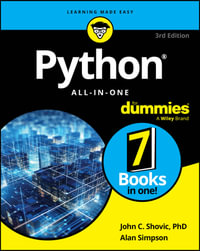
Python All-in-One For Dummies : 3rd Edition - John C. Shovic

RRP $74.95

$49.99

33%
OFF
Microsoft Power BI For Dummies : For Dummies (Computer/Tech) - Jack A. Hyman
Microsoft 365 Excel For Dummies : For Dummies (Computer/Tech) - David H. Ringstrom
The Singularity is Nearer : When We Merge with AI - Ray Kurzweil

RRP $26.99

$22.99

15%
OFF
How to Talk to AI : (And How Not To) - Jamie Bartlett
How To Think About AI : A Guide For The Perplexed - Richard  Susskind

RRP $25.95

$22.75

12%
OFF
Theory of Fun for Game Design - Raph Koster

RRP $85.75

$68.60

20%
OFF
Counseling the Culturally Diverse : Theory and Practice - Derald Wing Sue
Superintelligence : Paths, Dangers, Strategies - Nick Bostrom

RRP $32.95

$26.99

18%
OFF
Data-driven BIM for Energy Efficient Building Design : 1st Edition - Saeed Banihashemi
Design and Disability : 10 Tales of Accessible Design - Natalie Kane
HBR Guide to Generative AI for Managers : HBR Guide - Elisa Farri
Information Architecture : For the Web and Beyond : 4th Edition - Jorge Arango