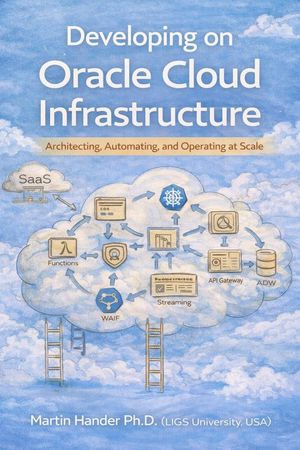
Developing on Oracle Cloud Infrastructure is a practical blueprint for building and running production systems on OCI, focused on architecture, automation, and day-two reliability rather than service catalogs or isolated "hello world" examples. It shows how to use OCI service families as building blocks that solve real problems: secure environments, scalable API platforms, burst handling, event-driven workflows, governed data pipelines, and operational excellence.
A central thread runs through the entire book: AuroraRetail 360, a realistic multi-tenant platform that evolves chapter by chapter. You'll start with a deployable landing zone and a clear separation of environments, then grow the platform into a cloud-native architecture: microservices on OKE, serverless Functions, streaming workflows for decoupled processing, and a protected transactional core. As the platform matures, you'll integrate with Oracle SaaS, especially Fusion ERP, using pragmatic integration patterns (Integration Cloud, Functions + adapters) and secure OAuth2/token exchange flows. The book also expands into data engineering and analytics, showing how to ingest events and logs into Object Storage, curate models in Autonomous Data Warehouse, and serve dashboards that remain fast even under peak retail load. Finally, it introduces AI/ML and MLOps patterns where models are trained, deployed, and monitored as first-class production components.
The emphasis throughout is on repeatability and operability. You'll learn how to codify environments with Terraform and Resource Manager, structure modules for multi-environment reuse, detect drift, and promote changes safely. You'll implement CI/CD pipelines that build immutable container images, push them to Container Registry, and deploy to OKE with approvals, canary rollouts, and fast rollback paths. Observability is treated as an operating model, not a dashboard collection, using SLOs, SLIs, error budgets, and runbooks for common incidents. Security engineering is woven into the architecture with identity-first access, Vault-based key and secret handling, WAF protection, encryption and masking patterns, and secure SDLC practices that scan containers, dependencies, and infrastructure templates before they ever reach production.
By the end, you won't just know what OCI services exist, you'll know how to assemble them into systems that can grow: more tenants, more regions, more teams, and more change, without becoming fragile.
What you'll learn
- Design a landing zone with compartments, policies, tagging, and guardrails that scale across teams
- Build and expose APIs safely with WAF, API Gateway, load balancing, and private OKE services
- Use event-driven architecture with Streaming, Queues, Notifications, and Functions for resilience and bursts
- Integrate with Oracle SaaS (Fusion ERP/HCM/CX) using secure token exchange and retryable patterns
- Build ingestion and analytics pipelines with Object Storage + ADW, plus curated models for BI tools
- Deliver continuously with IaC, CI/CD, GitOps-friendly practices, canaries, and rollback strategies
- Operate confidently with observability, SLOs, runbooks, and security engineering end-to-end
Who this book is for
This book is ideal for developers, platform engineers, DevOps/SRE practitioners, and cloud architects who want an end-to-end, production-minded guide to OCI. It's especially valuable if you're modernizing from on-prem systems, integrating SaaS, running multi-environment deployments, or building cloud-native platforms that must stay reliable under real traffic and real constraints.