Get Free Shipping on orders over $79
Decoding the Vedic System of Knowledge - HENRY ROMANO

Decoding the Vedic System of Knowledge

By: HENRY ROMANO

Paperback | 22 August 2022

At a Glance

Paperback


$32.99

or 4 interest-free payments of $8.25 with

 or 

Ships in 5 to 7 business days

One of the oldest libraries of texts in India is the Vedas. Vedic texts are painstakingly corrected by the teacher. Instructors and students still teach them orally today. Virtual classrooms have allowed females to learn the Vedas and how they were changed through technology.

Samaveda has a much more intricate connection with Rigveda than the other Vedas. Because all its verses except seventy-five are directly drawn from the Rigveda, it holds great historical significance. The eighth and especially the ninth of the Soma book provide the bulk of its content. It is similar to the Yajurveda in having been composed only for ritual use since the verses are all intended for chanting during the offering ceremonies. Unlike those in the Rigveda, these stanzas appear in the Sama-Veda as if they were to be spoken or recited. Their significance is solely determined by their relevance to particular rites, removed from their context in the Rigveda.

The Vedas have been the subject of voluminous literature over the centuries, written in many languages, including English. Due to their symbolic language, the Vedas remain elusive. Despite exploring every ancient Indian sourcebook, Shankara, Ramanuja, and Madhva did not write full commentaries on the Vedas. Vedas are enigmatic and ethereal, and this adds to their mystery. In contrast to the voluminous commentary on Upanishads, Bhagawad Gita, Brahma sutras, and Mahapuranas, Sri Madhva wrote a short Rigbhyasya. Sayana Madhava, also known as Sayanacharya, is the most common source of information on the Vedas. Vedic texts are covered in complete detail in this voluminous work, basically a literal translation of the Vedas. Those who criticize it point out that it ignores the Vedas' symbolism and the Vedic tenets' hidden meanings. It is for this reason that the Vedas remain inadequately illuminated. In addition, Vedic Sanskrit differs from classical Sanskrit, a currently taught, written, and spoken language. A widespread family of languages, the proto-Indo-European languages, is derived from it.

More in Asian History

The Great Transformation : China's Road from Revolution to Reform - Odd Arne Westad
The Rape of Nanking : The Forgotten Holocaust of World War II - Iris Chang
The Finest Hotel in Kabul : A People's History of Afghanistan - Lyse Doucet
The Shortest History of Japan - Lesley Downer

RRP $27.99

$23.75

15%
OFF
Israel on the Brink : Eight Steps for a Better Future - Ilan Pappe
The Golden Road : How Ancient India Transformed the World - William Dalrymple
Cactus Pear For My Beloved : Shortlisted for the 2025 Stella Prize - Samah Sabawi
Fly, Wild Swans : My Mother, Myself and China - Jung Chang

RRP $37.99

$30.75

19%
OFF
A Very Short History of the Israel-Palestine Conflict - Ilan Pappe
Israel : A Simple Guide to the Most Misunderstood Country on Earth - Noa Tishby
Crusader Criminals : The Knights Who Went Rogue in the Holy Land - Steve Tibble
Gaza : The Dream and the Nightmare - Julie M.  Norman

RRP $36.95

$29.75

19%
OFF
Eichmann in Jerusalem : A Report on the Banality of Evil - Hannah Arendt
Being Jewish After the Destruction of Gaza - Peter Beinart

RRP $34.99

$28.75

18%
OFF
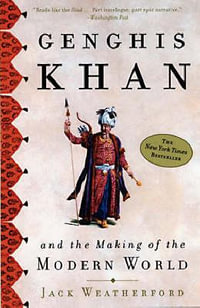
Genghis Khan : And the Making of the Modern World - Jack Weatherford

RRP $34.99

$28.75

18%
OFF
From Third World to First : Singapore and the Asian Economic Boom - Lee Kuan Yew