Get Free Shipping on orders over $79
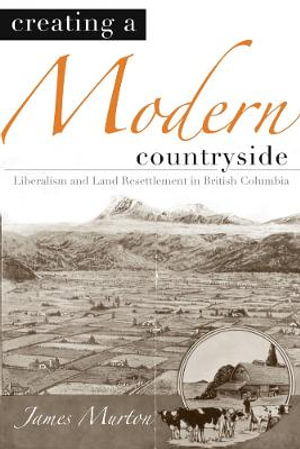
Creating a Modern Countryside : Liberalism and Land Resettlement in British Columbia - James Murton

Creating a Modern Countryside

Liberalism and Land Resettlement in British Columbia

By: James Murton

Hardcover | 30 June 2007

At a Glance

Hardcover


$228.75

or 4 interest-free payments of $57.19 with

 or 

Ships in 10 to 15 business days

In the early 1900s, British Columbia embarked on a brief but intense effort, with long consequences, to manufacture a modern countryside. For the first time, the state directly intervened in planning and implementing land settlement. "Creating a Modern Countryside" examines how this process unfolded and assesses its consequences. James Murton argues that the state's relationship to the environment was determined in the early twentieth century by the idea of centralized, "scientific" management of social problems by experts - known as progressivism or new liberalism. The efforts of new liberal experts to reshape forests and deserts into farmland largely failed, due to their inability to properly comprehend environmental and social complexity. Ultimately, Murton argues, the environment itself played a role in ending liberal land resettlement in the 1920s and 1930s. One ironic outcome of the program, however, was the expanded state apparatus that emerged after World War II with an even greater capacity to manage environmental change. "Creating a Modern Countryside" offers a new way of understanding the human-environmental relationship in the 20th century, and shows how this relationship shaped the province we live in today.
Industry Reviews

Murton's main contrubution to environmental history is his analysis of state formation whithin a region, an order that depended upon establishing a new and more direct relationship with the land. Creating a Modern Countryside opens up the possibility for an exploration of the intersection between state organization, landscape ideology, and culture in British Columbia ... As a recent addition to the Nature/ History/ Society series published by UBC Press and edited by Graeme Wynn, it fits well the aim to publish high quality, lively, innovative scholarship on the interaction of people and nature through time in North America ... It challenges us to think about how our constructions of the past need to be informed by an understanding of the environment. It is a good example of how environmental historians might 'get outside and into the dirt.'

-- Bruce Shelvey * Environmental History Journal, Volume 12, Number 4 *

In Creating a Modern Countryside, historian James Murton addresses British Columbia's distinctive attempts to promote in tandem particular ways of life and particular methods of land use. Through a case study approach to interwar land resettlement programs, Murton illustrates how "changes in the state and changes in the land were inextricably linked."

Murton's study exposes the complex entanglements of nature and the provincial state in a landscape that, for all Tourism British Columbia's efforts to promote the availability of beauty and pleasure, was not always amenable to human designs.

Murton's volume is an impressive contribution to the burgeoning subfield of Canadian environmental history, as well as an engagement with themes such as high modernism that are of importance to the international field of environmental history. And given its close engagement with liberalism, a topic of concern to Canadian historians at large, Creating a Modern Countryside is also one of the most compelling illustrations to date of why Canadian historians cannot afford to ignore the work of their environmental history colleagues.

As he details efforts at the creation of a modern countryside, Murton also provides valuable insight into the new liberal mindset, which has remained largely unexplored....

Murton promotes an expansive view of the field of environmental history, one in which the focus is not solely or necessarily on the most blatantly environmental human activities....

In addition to a penetrating analysis of new liberalism at work in interwar British Columbia, then, Murton's work is also an example of the sort of environmental history analysis that might be possible for other ideological perspectives or, to use his terminology, general logics.

...the book offers a vivid rendering of new liberalism in interwar British Columbia, an important contribution to key themes in the fields of Canadian and environmental history, and a compelling illustration of how these fields might benefit through greater recognition of their overlapping concerns....

-- Shannon Stunden Bower * H-Canada *

More in History of the Americas

The Shortest History of the United States of America - Don Watson
107 Days - Kamala Harris

Hardcover

RRP $49.99

$34.95

30%
OFF
Native America : The Story of the First Peoples - Kenneth L. Feder

RRP $69.99

$54.99

21%
OFF
The Greatest Sentence Ever Written - Walter Isaacson
Dragon on Centre Street : New York vs. Donald J. Trump - Jonah Bromwich
The Israel Lobby and US Foreign Policy - John J Mearsheimer
The Witches : Salem, 1692 - Stacy Schiff

RRP $26.99

$22.99

15%
OFF
Zbig : The Life of Zbigniew Brzezinski, America's Cold War Prophet - Edward Luce
America Tees Off : True Tales of Golf's Rich History - David Sowell
A Concise History Of American Law - William E. Nelson
Fifth Sun : A New History of the Aztecs - Camilla  Townsend

RRP $45.95

$35.99

22%
OFF