Get Free Shipping on orders over $79
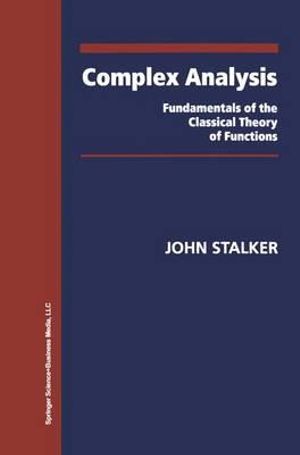
Complex Analysis : Fundamentals of the Classical Theory of Functions - John Stalker

Complex Analysis

Fundamentals of the Classical Theory of Functions

By: John Stalker

Paperback | 21 October 2009

At a Glance

Paperback


$84.99

or 4 interest-free payments of $21.25 with

 or 

Ships in 5 to 7 business days

All modem introductions to complex analysis follow, more or less explicitly, the pattern laid down in Whittaker and Watson [75]. In "part I'' we find the foundational material, the basic definitions and theorems. In "part II" we find the examples and applications. Slowly we begin to understand why we read part I. Historically this is an anachronism. Pedagogically it is a disaster. Part II in fact predates part I, so clearly it can be taught first. Why should the student have to wade through hundreds of pages before finding out what the subject is good for? In teaching complex analysis this way, we risk more than just boredom. Beginning with a series of unmotivated definitions gives a misleading impression of complex analy­ sis in particular and of mathematics in general. The classical theory of analytic functions did not arise from the idle speculation of bored mathematicians on the possible conse­ quences of an arbitrary set of definitions; it was the natural, even inevitable, consequence of the practical need to answer questions about specific examples. In standard texts, after hundreds of pages of theorems about generic analytic functions with only the rational and trigonometric functions as examples, students inevitably begin to believe that the purpose of complex analysis is to produce more such theorems. We require introductory com­ plex analysis courses of our undergraduates and graduates because it is useful both within mathematics and beyond.
Industry Reviews

From the reviews:

The first chapter deals with a beautiful presentation of special functions... The third chapter covers elliptic and modular functions...in much more detail, and from a different point of view, than one can find in standard introductory books... For [the] subjects that are omitted, the author has suggested some excellent references for the reader who wants to go through these topics. The book is read easily and with great interest. It can be recommended to both students as a textbook and to mathematicians and physicists as a useful reference.

---Mathematical Reviews

Mainly original papers are cited to suppoert the historical remarks. The book is well readable.

---ZentralblattMATH

This is an unusual textbook, incorporating material showing how classical function theory can be used. The general scheme is to show the reader how things were developed without following the traditional approach of most books on functional theory. This book can be recommended to those who like to see applications of the theory taught in "classical courses".

---EMS

"The intended audience for this book is anyone who has taken a calculus course, who knows or is willing to believe the elementary theorems of real analysis given in the appendix, and who wants to learn the classical theory of analytic functions. ... The book is easy to read and with great interest. It can be recommended to both students as a textbook and to mathematicians and physicists as a useful reference." (Vasily A. Chernecky, Zentralblatt MATH, Vol. 1188, 2010)

More in Calculus & Mathematical Analysis

The Maths Book : Big Ideas Simply Explained - DK

RRP $42.99

$32.99

23%
OFF
Calculus : 9th edition - Early Transcendentals, Metric - James Michael Stewart
Calculus Essentials - Travis Madden

$452.75

Introductory Numerical Analysis - Griffin Cook
Calculus : A Comprehensive Course - Megan Baker
Calculus : 3rd Edition - Michael Spivak

RRP $97.95

$80.75

18%
OFF
Essential Calculus : 2nd Edition - James Stewart

RRP $219.95

$164.75

25%
OFF
A Second Course in Statistics : 7th Edition - Regression Analysis - Terry Sincich

RRP $185.35

$138.75

25%
OFF
Calculus, Metric Edition : 9th edition - James Michael Stewart

RRP $184.95

$146.75

21%
OFF
The Cartoon Guide to Calculus : Cartoon Guide Series - Larry Gonick