Get Free Shipping on orders over $79
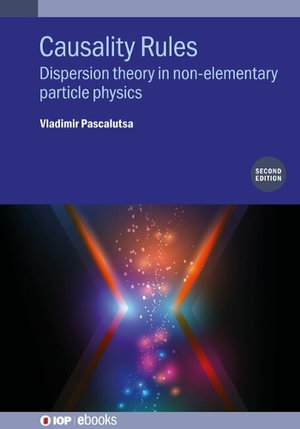
Causality Rules (Second Edition) : Dispersion theory in non-elementary particle physics - Vladimir  Pascalutsa

Causality Rules (Second Edition)

Dispersion theory in non-elementary particle physics

By: Vladimir Pascalutsa

Hardcover | 24 April 2024 | Edition Number 2

At a Glance

Hardcover


$253.75

or 4 interest-free payments of $63.44 with

 or 

Ships in 5 to 7 business days

Causality: Cause and effect. In classical physics, an effect cannot occur before its cause. In Einstein's theory of special relativity, causality means that an effect cannot occur from a cause that is not in the back (past) light cone of that event.

The books cover the useful physical relations inferred by unitarity and causality. A famous example is the Kramers-Kronig relation for the refractive index of a gas or dilute medium. For example, in Chapter 3 generalises the Kramers-Kronig relation to relativistic medium, such as CMB (photon gas). These relations are extensively also used in particle and nuclear physics. Especially useful are the so-called "sum rules", such as the Gerasimov-Drell-Hearn (GDH) or the Baldin sum rule.

The author notes that the first edition is too brief. In his teaching practice, he sees that is is challenging to use as a standalone text. He intends to improve the explanations of many topics that students found particularly challenging. The additional material will make the book more timely, self-contained, and logically complete.

Key Features:

  • Modern book on a timely subject
  • Classroom friendly and built on newly developed courses taught at a major Physics Department in Germany
  • Advanced material written in simple non-technical language
  • Includes pedagogical examples and discussions of the current forefront research
Industry Reviews

Causality is the relationship between a cause and its effect: an effect cannot occur before its cause. This concept is usually found in optics and electromagnetism as well as in Einstein's theories of special and general relativity.

This book is pleasant and contains careful discussions of a large number of topics dealing with the multifaceted aspects of causality such as Kramers-Kr¶nig relations and sum rules. The book includes many pedagogical examples such as light-by-light scattering, nonlinear optics, and dispersion of rays in cosmic microwave background. Its target audience includes undergraduate and graduate students of optics, particle physics and astrophysics.

Christian Brosseau, Optica, 23 May 2024

More in Optical Physics

Modern Optics - Carl MacKenzie

Hardcover

$458.99

Physical Optics - Frank Bailey

$464.75

Principles of Optics - Summer Nolan

$453.75

Photoelectrochemistry of Semiconductors - Anders Hagfeldt

RRP $292.00

$252.75

13%
OFF
Optical Fiber Sensors : Technology and Applications - Tarun Kumar Gangopadhyay

RRP $315.00

$271.99

14%
OFF
Optical Networks and Components : Fundamentals and Advances - Partha Pratim Sahu
Essentials of Light Microscopy - Jeremy Sanderson
Colour : How We See It And How We Use It - Michael Mark  Woolfson

RRP $61.99

$55.99

10%
OFF
VORTEX ATOM, THE : A NEW PARADIGM - CLARKE BARRY R

RRP $176.99

$159.75

10%
OFF
Vibrations and Waves : Manchester Physics Series - George C. King

RRP $95.95

$72.75

24%
OFF