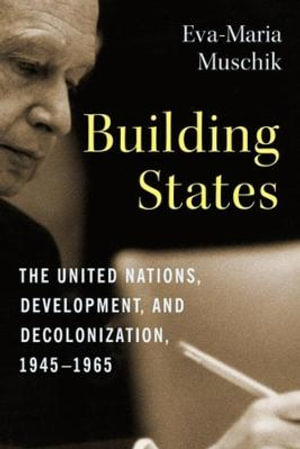
Postwar multilateral cooperation is often viewed as an attempt to overcome the limitations of the nation-state system. However, in 1945, when the United Nations was founded, large parts of the world were still under imperial control. Building States investigates how the UN tried to manage the dissolution of European empires in the 1950s and 1960s-and helped transform the practice of international development and the meaning of state sovereignty in the process.
Eva-Maria Muschik argues that the UN played a key role in the global proliferation and reinvention of the nation-state in the postwar era, as newly independent states came to rely on international assistance. Drawing on previously untapped primary sources, she traces how UN personnel-usually in close consultation with Western officials-sought to manage decolonization peacefully through international development assistance. Examining initiatives in Libya, Somaliland, Bolivia, the Congo, and New York, Muschik shows how the UN pioneered a new understanding and practice of state building, presented as a technical challenge for international experts rather than a political process. UN officials increasingly took on public-policy functions, despite the organization's mandate not to interfere in the domestic affairs of its member states. These initiatives, Muschik suggests, had lasting effects on international development practice, peacekeeping, and post-conflict territorial administration.
Casting new light on how international organizations became major players in the governance of developing countries, Building States has significant implications for the histories of decolonization, the Cold War, and international development.
About the Author
Eva-Maria Muschik is a historian and an assistant professor in the Department of Development Studies at the University of Vienna.
Industry Reviews
The formation of the United Nations in 1945 proved essential to the decolonization of the world, as Eva-Maria Muschik elegantly demonstrates in this state-of-the-art international history. In its first twenty years, the UN machinery was instrumental in new states' attainment of formal sovereignty-and played an even more pivotal role in the development of many new states after their emergence. Revising our understanding of an era in which the UN's contribution has often been criticized or trivialized, Muschik has transformed the study of international governance. -- Samuel Moyn, Yale University
Building States is a highly original book. It pushes forward our understanding of the international history of the United Nations, and it also acts as a powerful corrective to studies that lionize uncritically the work of the UN. -- Alessandro Iandolo, Harvard University
Building States will find an enthusiastic audience among historians and IR scholars interested in international organizations and development. Muschik's focus on public administration is an important addition to the wealth of studies on agricultural and infrastructural development projects. Through a series of well-researched case studies, Muschik explores how "technical assistance" came to emphasize state-building as a job best handled by professionals and reveals how subtle (and not so subtle) tensions between ideals of expertise and democracy played out in practice. -- Perrin Selcer, author of The Postwar Origins of the Global Environment: How the United Nations Built Spaceship Earth
An ambitious book in its chronological, geographic and thematic scope, offering one perspective on the vast scale of UN interventions across the global South during the era of decolonization. * International Affairs *
With new insight into how international organisations became major players in governance and development,
Building States has significant implications for the histories of decolonization, UN intervention and the Cold War. * e-IR *
The book has outstanding qualities, which make it more than worth reading. Building States makes a poignant case for the agency not only of the Secretariat but also of the new and small states. * International Peacekeeping *
[A] fascinating inquiry, [that] explores the role of the United Nations in the great post-World War II transition from a world of empires to a postcolonial system of nation-states. -- G. John Ikenberry * Foreign Affairs *