Get Free Shipping on orders over $79
Boundary Element Methods for Soil-Structure Interaction - W.S. Hall

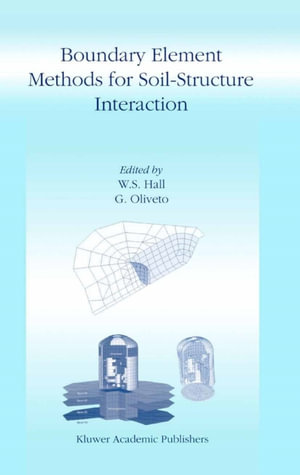
Boundary Element Methods for Soil-Structure Interaction

By: W.S. Hall, ?G. Oliveto

eText | 8 May 2007 | Edition Number 1

At a Glance

eText


$239.00

or 4 interest-free payments of $59.75 with

 or 

Instant online reading in your Booktopia eTextbook Library *

Why choose an eTextbook?

Instant Access *

Purchase and read your book immediately

Read Aloud

Listen and follow along as Bookshelf reads to you

Study Tools

Built-in study tools like highlights and more

* eTextbooks are not downloadable to your eReader or an app and can be accessed via web browsers only. You must be connected to the internet and have no technical issues with your device or browser that could prevent the eTextbook from operating.
W S HALL School of Computing and Mathematics, University of Teesside, Middlesbrough, TS1 3BA UK G OLIVETO Division of Structural Engineering, Department of Civil and Environmental Engineering, University of Catania, Viale A. Doria 6, 95125 Catania, Italy Soil-Structure Interaction is a challenging multidisciplinary subject which covers several areas of Civil Engineering. Virtually every construction is connected to the ground and the interaction between the artefact and the foundation medium may affect considerably both the superstructure and the foundation soil. The Soil-Structure Interaction problem has become an important feature of Structural Engineering with the advent of massive constructions on soft soils such as nuclear power plants, concrete and earth dams. Buildings, bridges, tunnels and underground structures may also require particular attention to be given to the problems of Soil-Structure Interaction. Dynamic Soil-Structure Interaction is prominent in Earthquake Engineering problems. The complexity of the problem, due also to its multidisciplinary nature and to the fact of having to consider bounded and unbounded media of different mechanical characteristics, requires a numerical treatment for any application of engineering significance. The Boundary Element Method appears to be well suited to solve problems of Soil- Structure Interaction through its ability to discretize only the boundaries of complex and often unbounded geometries. Non-linear problems which often arise in Soil-Structure Interaction may also be treated advantageously by a judicious mix of Boundary and Finite Element discretizations.
on
Desktop
Tablet
Mobile

More in Engineering in General

SAFE : Science and Technology in the Age of Ter - Martha Baer

eBOOK

The Shabby Chic Home - Rachel Ashwell

eBOOK

Shabby Chic - Rachel Ashwell

eBOOK

$17.99

Star Commercial Spaces - Julio Fajardo

eBOOK