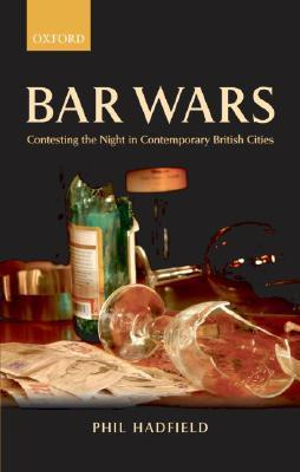
In Britain today, if you are in the business of fighting crime, then you have to be in the business of dealing with alcohol. ''Binge-drinking'' culture is intrinsic to urban leisure and has come to pose a key threat to public order. Unsurprisingly, a struggle is occurring. Pub and club companies, local authorities, central government, the police, the judiciary, local residents, and revellers, all hold variously competing notions of night-time social order and the uses and meanings of public and private space.Bar Wars explores the issue of contestation within and between these groups. Located within a long tradition of urban ethnography, the book offers unique and hard-hitting analyses of social control in bars and clubs, courtroom battles between local communities and the drinks industry, and street-level policing, These issues go the heart of contemporary debates on anti-social behaviour and were hotly debated during the development of the Licensing Act 2003 and its contentious passage through parliament.The book presents a controversial critique of recent shifts in national alcohol policy. It uses historical, documentary, interview, and observational methods to chart the emergence of the ''night-time high street,'' a social environment set aside for the exclusive purposes of mass hedonistic consumption, and describes the political and regulatory struggles that help shape important aspects of urban life. The book identifies the adversarial licensing trial as a key arena of contestation and describes how leisure corporations and their legal champions circumvent regulatory control in courtroom duels with subordinate opponents. The author''s experiences as an expert witness to the licensing courts provide a unique perspective, setting his work apart from other academic commentators. Bar Wars takes the study of the night-time economy to a new level of sophistication, making it essential reading for all those wishing to understand the governance of crime and social order in contemporary cities.
Industry Reviews
`An insider's view of the exploitative and occassional ruthless underbelly of the licensed venues that populate the British 'high-street'... The power plays, the striking deals, competition for prized locations and the stockpiling of transferable licenses, summon up images of a giant game of monopoly played out on real streets with real hotels and really big dollars...(the author) leaves us in no doubt of his authenticity and personal credentials for
writing this book...Timely, intelligently written, supported by insight from personal experience - but tempered with academic rigour - Bar Wars is recommended reading for anyone interested in the inexorable and
complex relations between the late-drinking environment, crime, regulation, governace and policy'
Drug and Alcohol Review
Hadfield's analysis of licensing procedure was both original and remarkably insightful, and points the way for further ethnographic work on licensing trials, given their huge potential to shape strategy at the local and national levels
`Hadfield provides a powerful critique of the existing licensing system and its inability to reflect on, and respond to, evidence relating to criminality in licensed spaces. His conclusion that an inquisitorial mode of licensing hearing would lead to fairer and more representative licensing decisions is unquestionable'
British Journal of Criminology
Provides an ideal introduction to the debates raging over the shape and form of the British night-time economy.
an important and timely intervention in debates around drinking, night-life, and the changing moralities of urban consumption
Hadfield's analysis of licensing procedure was both original and remarkably insightful, and points the way for further ethnographic work on licensing trials, given their huge potential to shape strategy at the local and national levels
`Hadfield provides a powerful critique of the existing licensing system and its inability to reflect on, and respond to, evidence relating to criminality in licensed spaces. His conclusion that an inquisitorial mode of licensing hearing would lead to fairer and more representative licensing decisions is unquestionable'
British Journal of Criminology