Get Free Shipping on orders over $79
Backdoor Attacks against Learning-Based Algorithms : Computer Science (R0) - Shaofeng Li

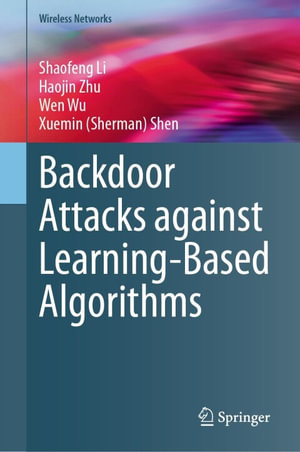
Backdoor Attacks against Learning-Based Algorithms

By: Shaofeng Li, Haojin Zhu, Wen Wu, () (Sherman) Shen

eText | 29 May 2024

At a Glance

eText


$249.00

or 4 interest-free payments of $62.25 with

 or 

Instant online reading in your Booktopia eTextbook Library *

Why choose an eTextbook?

Instant Access *

Purchase and read your book immediately

Read Aloud

Listen and follow along as Bookshelf reads to you

Study Tools

Built-in study tools like highlights and more

* eTextbooks are not downloadable to your eReader or an app and can be accessed via web browsers only. You must be connected to the internet and have no technical issues with your device or browser that could prevent the eTextbook from operating.

This book introduces a new type of data poisoning attack, dubbed, backdoor attack. In backdoor attacks, an attacker can train the model with poisoned data to obtain a model that performs well on a normal input but behaves wrongly with crafted triggers. Backdoor attacks can occur in many scenarios where the training process is not entirely controlled, such as using third-party datasets, third-party platforms for training, or directly calling models provided by third parties. Due to the enormous threat that backdoor attacks pose to model supply chain security, they have received widespread attention from academia and industry. This book focuses on exploiting backdoor attacks in the three types of DNN applications, which are image classification, natural language processing, and federated learning.

Based on the observation that DNN models are vulnerable to small perturbations, this book demonstrates that steganography and regularization can be adopted to enhance the invisibility of backdoor triggers. Based on image similarity measurement, this book presents two metrics to quantitatively measure the invisibility of backdoor triggers. The invisible trigger design scheme introduced in this book achieves a balance between the invisibility and the effectiveness of backdoor attacks. In the natural language processing domain, it is difficult to design and insert a general backdoor in a manner imperceptible to humans. Any corruption to the textual data (e.g., misspelled words or randomly inserted trigger words/sentences) must retain context-awareness and readability to human inspectors. This book introduces two novel hidden backdoor attacks, targeting three major natural language processing tasks, including toxic comment detection, neural machine translation, and question answering, depending on whether the targeted NLP platform accepts raw Unicode characters.

The emerged distributed training framework, i.e., federated learning, has advantages in preserving users' privacy. It has been widely used in electronic medical applications, however, it also faced threats derived from backdoor attacks. This book presents a novel backdoor detection framework in FL-based e-Health systems. We hope this book can provide insightful lights on understanding the backdoor attacks in different types of learning-based algorithms, including computer vision, natural language processing, and federated learning. The systematic principle in this book also offers valuable guidance on the defense of backdoor attacks against future learning-based algorithms.

on
Desktop
Tablet
Mobile

More in Artificial Intelligence

AI-Powered Search - Trey Grainger

eBOOK

AI : The End of Human Race - Alex Wood

eBOOK

HBR Guide to Generative AI for Managers : HBR Guide - Elisa Farri

eBOOK