




Instant online reading.
Don't wait for delivery!
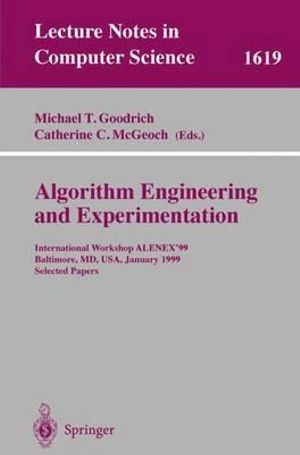
Algorithm Engineering and Experimentation
International Workshop ALENEX'99 Baltimore, MD, USA, January 15-16, 1999, Selected Papers
By: Michael T. Goodrich (Editor), Catherine C. McGeoch (Editor)
Paperback | 29 June 1999
At a Glance
Paperback
$84.99
Ships in 5 to 7 business days
ISBN: 9783540662273
ISBN-10: 3540662278
Series: Lecture Notes in Computer Science
Published: 29th June 1999
Format: Paperback
Language: English
Number of Pages: 364
Audience: General Adult
Publisher: Springer Nature B.V.
Country of Publication: DE
Dimensions (cm): 24.77 x 15.88 x 1.91
Weight (kg): 0.51
Shipping
| Standard Shipping | Express Shipping | |
|---|---|---|
| Metro postcodes: | $9.99 | $14.95 |
| Regional postcodes: | $9.99 | $14.95 |
| Rural postcodes: | $9.99 | $14.95 |
Orders over $0.00 qualify for free shipping.
How to return your order
At Booktopia, we offer hassle-free returns in accordance with our returns policy. If you wish to return an item, please get in touch with Booktopia Customer Care.
Additional postage charges may be applicable.
Defective items
If there is a problem with any of the items received for your order then the Booktopia Customer Care team is ready to assist you.
For more info please visit our Help Centre.
You Can Find This Book In
RRP $74.95
$52.47
OFF


RRP $107.04
$75.75
OFF
RRP $89.99
$64.99
OFF
RRP $45.00
$35.75
OFF
RRP $138.95
$108.75
OFF


$97.75





RRP $91.30
$65.75
OFF


RRP $152.00
$73.75
OFF

RRP $133.00
$64.75
OFF
This product is categorised by
- Non-FictionComputing & I.T.Computer Programming & Software DevelopmentAlgorithms & Data Structures
- Non-FictionComputing & I.T.Computer Science
- Non-FictionComputing & I.T.Graphical & Digital Media Applications3D Graphics & Modelling
- Non-FictionComputing & I.T.DatabasesData Capture & Analysis
- Non-FictionMathematicsOptimisationLinear Programming
- Non-FictionMathematicsCalculus & Mathematical Analysis