


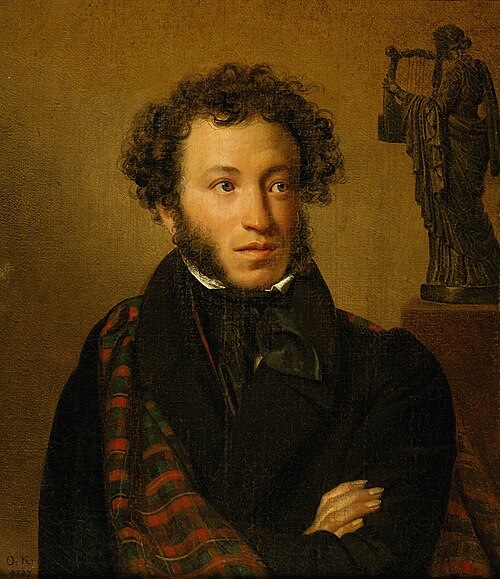
Alexander Pushkin
"It's a lucky man, a very lucky man, who is committed to what he believes, who has stifled intellectual detachment and can relax in the luxury of his emotions - like a tipsy traveller resting for the n"
Alexander Sergeyevich Pushkin was a renowned Russian poet, playwright and novelist. He is one of the great writers of the Romantic era and is widely regarded as Russia’s greatest poet of all time.
His work Eugene Onegin is often called the founding text of modern Russian literature. It tells the story of a man who moves from St Petersburg to a country estate, becomes caught in a love triangle, and ultimately finds himself in a tragedy of his own making. Another of Pushkin’s most popular works is Boris Godunov, a drama of high stakes and rich storytelling.
Meet Alexander Pushkin
Alexander Pushkin was born in Moscow in 1799 to Russian nobility. He grew up with French tutors and mostly spoke French at home.
He attended a prestigious school and published his first poem at just fifteen. By the time he graduated he was already gaining attention on the literary scene. Influenced by the teachings of Voltaire, Pushkin became interested in social reform, which brought him into conflict with the authorities and eventually led to exile from the city.
Pushkin spent several years moving around, writing poetry and clashing with governments. Eventually he met Emperor Nicholas I and was released from Moscow exile, though he remained under close supervision.
In 1831 Pushkin married a young beauty and the couple became prominent figures in Moscow society. Rumours that his wife was having an affair eventually led Pushkin to duel with Georges d’Anthès. Pushkin was critically wounded and died two days later at the age of thirty-seven.
Despite his short life, Pushkin left an enormous literary legacy. His poem The Bronze Horseman remains widely admired, as does his drama The Stone Guest. Many works inspired operas, including Ruslan and Lyudmila, Tchaikovsky’s Eugene Onegin, and The Queen of Spades.
After his death he was honoured in many ways, including monuments, literary tributes, the renaming of places, and even a commemorative rouble coin and a minor planet bearing his name.
What genres and literary forms did Alexander Pushkin write in?
Pushkin wrote across several genres: poetry, drama and the novel (particularly the novel in verse). He is a central figure of the Romantic era and widely regarded as Russia’s greatest poet.
What are Pushkin’s major works I should read first?
Key works include Eugene Onegin (often described as the founding text of modern Russian literature), the drama Boris Godunov, and the famous poem The Bronze Horseman. Shorter poetry collections can also serve as a good introduction.
What themes recur in Pushkin’s writing?
His works often explore themes such as love and fate, social reform, the tensions of Russian society, and Romantic ideas about emotion, individuality and destiny.
Are there notable adaptations of his works?
Yes. Several works inspired major operas and adaptations, including Ruslan and Lyudmila, Tchaikovsky’s Eugene Onegin, and The Queen of Spades.
What is Pushkin’s literary legacy?
Pushkin is celebrated as a founder of modern Russian literature. After his death he was honoured with monuments, commemorative coins, place names, literary tributes and even a minor planet named in his honour.