


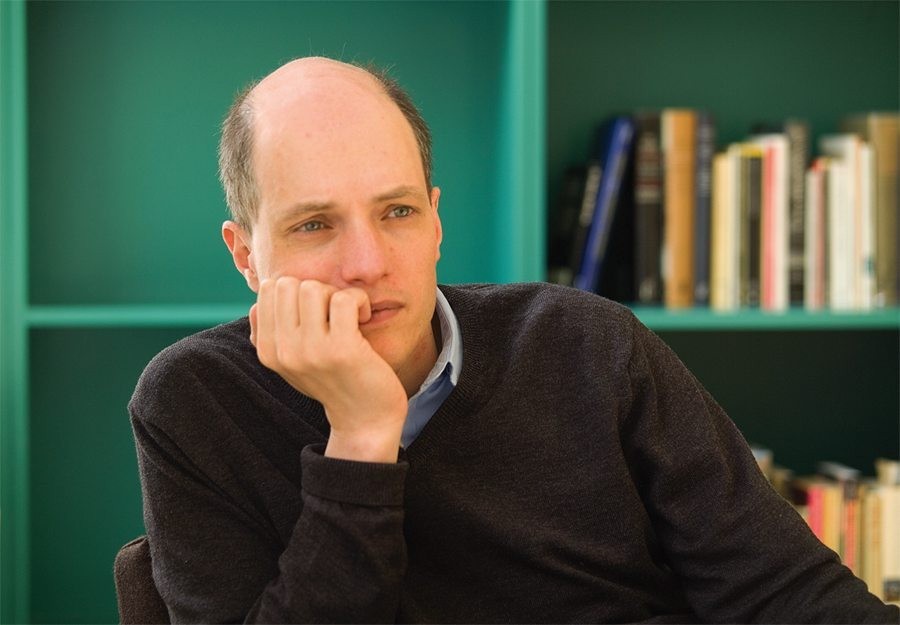
Alain de Botton
"Authors write things down so as to have to think of them less."
Alain started writing at a young age. His first book, Essays in Love (titled On Love in the US), was published when he was twenty-three. It minutely analysed the process of falling in and out of love, in a style that mixed elements of a novel with reflections and analyses normally found in non-fiction. It remains one of his most beloved works and has sold two million copies worldwide.
It was with How Proust Can Change Your Life that Alain’s work reached a truly global audience. The book was particularly successful in the United States, where its ironic self-help framing combined with an analysis of one of the most revered yet unread works in Western literature struck a chord. It was followed by The Consolations of Philosophy, which in many ways acted as a companion volume. Though sometimes described as popularisations, these books attempt to develop original ideas—about friendship, art, envy, desire and inadequacy—using the thoughts of earlier thinkers such as Seneca and Montaigne.
Alain then returned to a more lyrical, personal style of writing. In The Art of Travel, he explored the psychology of travel—how we imagine places before seeing them, how we remember beauty, and what happens when we encounter landscapes, hotels or countryside settings. In Status Anxiety, he examined a common but rarely discussed fear: how others judge our success or failure. In The Architecture of Happiness, he explored questions of beauty and ugliness in architecture, drawing inspiration even from the ordinary surroundings near his home in West London.
The Pleasures and Sorrows of Work followed Alain as he travelled the world with a photographer, exploring people in their workplaces and reflecting on the meaning of work: why we do it, how it might become more fulfilling, and what makes a meaningful life.
In the summer of 2009, Alain was appointed Heathrow’s first Writer-in-Residence and wrote about the experience in A Week at the Airport.
Aside from writing, de Botton has been involved in producing television documentaries and helps run a production company, Seneca Productions.
In 2008 he helped launch a miniature “university” called The School of Life, which aims to explore life’s big questions and help people live better. He also helped start the organisation Living Architecture, which commissions modern architectural works for public rental across the UK. In 2009 he was made an honorary fellow of the Royal Institute of British Architects in recognition of his contributions to architecture.
Follow Alain de Botton on Twitter
Customer Comment: He is the thinking woman's crumpet.
What kinds of books does Alain de Botton write and what themes does he explore?
He writes essayistic, accessible philosophy often described as a “philosophy of everyday life.” Common themes include love, travel, architecture, literature, work, status, art and how philosophical ideas apply to daily living.
Which of his books are most well known or recommended?
Notable titles include Essays in Love (On Love in the US), How Proust Can Change Your Life, The Consolations of Philosophy, The Art of Travel, Status Anxiety, The Architecture of Happiness, The Pleasures and Sorrows of Work, A Week at the Airport and The Course of Love.
Where should I start if I’m new to his work?
Good entry points include Essays in Love (On Love) for its blend of narrative and reflection, How Proust Can Change Your Life for its accessible philosophical insights, or The Consolations of Philosophy for short, theme-based essays.
Are his books part of a series or should they be read in order?
His books are generally standalone works that share recurring themes rather than forming a single series. Some books act as companions (for example How Proust Can Change Your Life and The Consolations of Philosophy), but no specific reading order is required.
Has Alain de Botton received notable recognition for his work?
His books have been bestsellers in around 30 countries. He was appointed Heathrow’s first Writer-in-Residence and in 2009 became an honorary fellow of the Royal Institute of British Architects. He also co-founded The School of Life and the Living Architecture project.
Popular Books By Alain de Botton

RRP $27.99
$23.75
OFF

RRP $15.99
$15.75


RRP $24.99
$21.75
OFF
All Alain de Botton Books
RRP $27.99
$23.75
OFF

$38.75
RRP $15.99
$15.75

RRP $29.95
$24.99
OFF

RRP $16.99
$15.99
RRP $24.99
$21.75
OFF