In just a few years, deep reinforcement learning (DRL) systems such as DeepMinds DQN have yielded remarkable results. This hybrid approach to machine learning shares many similarities with human learning: its unsupervised self-learning, self-discovery of strategies, usage of memory, balance of exploration and exploitation, and its exceptional flexibility. Exciting in its own right, DRL may presage even more remarkable advances in general artificial intelligence.
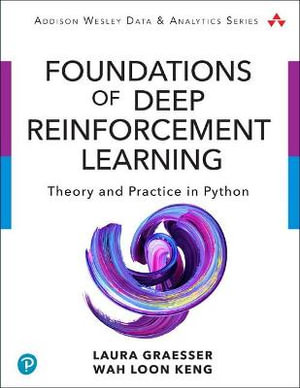
Deep Reinforcement Learning in Python: A Hands-On Introduction is the fastest and most accessible way to get started with DRL. The authors teach through practical hands-on examples presented with their advanced OpenAI Lab framework. While providing a solid theoretical overview, they emphasize building intuition for the theory, rather than a deep mathematical treatment of results. Coverage includes:
- Components of an RL system, including environment and agents
- Value-based algorithms: SARSA, Q-learning and extensions, offline learning
- Policy-based algorithms: REINFORCE and extensions; comparisons with value-based techniques
- Combined methods: Actor-Critic and extensions; scalability through async methods
- Agent evaluation
- Advanced and experimental techniques, and more
- How to achieve breakthrough machine learning performance by combining deep neural networks with reinforcement learning
- Reduces the learning curve by relying on the authorsâ OpenAI Lab framework: requires less upfront theory, math, and programming expertise
- Provides well-designed, modularized, and tested code examples with complete experimental data sets to illuminate the underlying algorithms
- Includes case studies, practical tips, definitions, and other aids to learning and mastery
- Prepares readers for exciting future advances in artificial general intelligence
The accessible, hands-on, full-color tutorial for building practical deep reinforcement learning solutions - How to achieve breakthrough machine learning performance by combining deep neural networks with reinforcement learning
- Reduces the learning curve by relying on the authorsâ OpenAI Lab framework: requires less upfront theory, math, and programming expertise
- Provides well-designed, modularized, and tested code examples with complete experimental data sets to illuminate the underlying algorithms
- Includes case studies, practical tips, definitions, and other aids to learning and mastery
- Prepares readers for exciting future advances in artificial general intelligence
Industry Reviews
“This book provides an accessible introduction to deep reinforcement learning covering the mathematical concepts behind popular algorithms as well as their practical implementation. I think the book will be a valuable resource for anyone looking to apply deep reinforcement learning in practice.”–Volodymyr Mnih, lead developer of DQN“An excellent book to quickly develop expertise in the theory, language, and practical implementation of deep reinforcement learning algorithms. A limpid exposition which uses familiar notation; all the most recent techniques explained with concise, readable code, and not a page wasted in irrelevant detours: it is the perfect way to develop a solid foundation on the topic.”–Vincent Vanhoucke, principal scientist, Google“As someone who spends their days trying to make deep reinforcement learning methods more useful for the general public, I can say that Laura and Keng’s book is a welcome addition to the literature. It provides both a readable introduction to the fundamental concepts in reinforcement learning as well as intuitive explanations and code for many of the major algorithms in the field. I imagine this will become an invaluable resource for individuals interested in learning about deep reinforcement learning for years to come.”–Arthur Juliani, senior machine learning engineer, Unity Technologies“Until now, the only way to get to grips with deep reinforcement learning was to slowly accumulate knowledge from dozens of different sources. Finally, we have a book bringing everything together in one place.”–Matthew Rahtz, ML researcher, ETH Zürich