Get Free Shipping on orders over $79
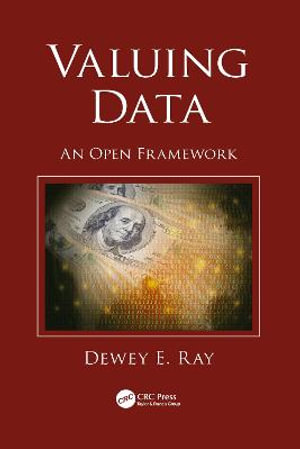
Valuing Data : An Open Framework - Dewey Ray

Valuing Data

An Open Framework

By: Dewey Ray

eText | 25 May 2018 | Edition Number 1

At a Glance

eText


$97.90

or 4 interest-free payments of $24.48 with

 or 

Instant online reading in your Booktopia eTextbook Library *

Why choose an eTextbook?

Instant Access *

Purchase and read your book immediately

Read Aloud

Listen and follow along as Bookshelf reads to you

Study Tools

Built-in study tools like highlights and more

* eTextbooks are not downloadable to your eReader or an app and can be accessed via web browsers only. You must be connected to the internet and have no technical issues with your device or browser that could prevent the eTextbook from operating.

The past decade has seen a dramatic increase in the amount and variety of information that is generated and stored electronically by business enterprises. Storing this increased volume of information has not been a problem to date, but as these information stores grow larger and larger, multiple challenges arise for senior management: namely, questions such as "How much is our data worth?" "Are we storing our data in the most cost-effective way?" "Are we managing our data effectively and efficiently?" "Do we know which data is most important?" "Are we extracting business insight from the right data?" "Are our data adding to the value of our business?" "Are our data a liability?" "What is the potential for monetizing our data?" and "Do we have an appropriate risk management plan in place to protect our data?"

To answer these value-based questions, data must be treated with the same rigor and discipline as other tangible and intangible assets. In other words, corporate data should be treated as a potential asset and should have its own asset valuation methodology that is accepted by the business community, the accounting and valuation community, and other important stakeholder groups. Valuing Data: An Open Framework is a first step in that direction. Its purpose is to:

  • Provide the reader with some background on the nature of data
  • Present the common categories of business data
  • Explain the importance of data management
  • Report the current thinking on data valuation
  • Offer some business reasons to value data
  • Present an "open framework"—along with some proposed methods—for valuing data

The book does not aim to prescribe exactly how data should be valued monetarily, but rather it is a "starting point" for a discussion of data valuation with the objective of developing a stakeholder consensus, which, in turn, will become accepted standards and practices.

on
Desktop
Tablet
Mobile

Other Editions and Formats

Paperback

Published: 30th June 2021

More in Databases

China's Megatrends : The 8 Pillars of a New Society - John Naisbitt

eBOOK

AI-Powered Search - Trey Grainger

eBOOK

Investing for Programmers - Stefan Papp

eBOOK

Transformers in Action - Nicole Koenigstein

eBOOK

Conquering the Decision Abyss - Keith Hartley

eBOOK

RRP $15.39

$14.99