Get Free Shipping on orders over $79
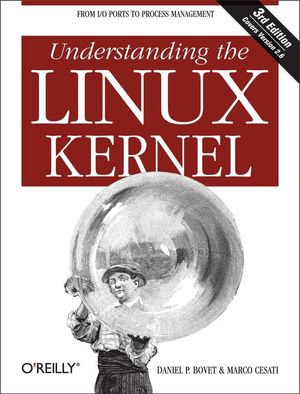
Understanding the Linux Kernel : From I/O Ports to Process Management - Daniel P. Bovet

Understanding the Linux Kernel

From I/O Ports to Process Management

By: Daniel P. Bovet, Marco Cesati

eText | 17 November 2005 | Edition Number 3

At a Glance

eText


$60.49

or 4 interest-free payments of $15.12 with

 or 

Instant online reading in your Booktopia eTextbook Library *

Why choose an eTextbook?

Instant Access *

Purchase and read your book immediately

Read Aloud

Listen and follow along as Bookshelf reads to you

Study Tools

Built-in study tools like highlights and more

* eTextbooks are not downloadable to your eReader or an app and can be accessed via web browsers only. You must be connected to the internet and have no technical issues with your device or browser that could prevent the eTextbook from operating.

In order to thoroughly understand what makes Linux tick and why it works so well on a wide variety of systems, you need to delve deep into the heart of the kernel. The kernel handles all interactions between the CPU and the external world, and determines which programs will share processor time, in what order. It manages limited memory so well that hundreds of processes can share the system efficiently, and expertly organizes data transfers so that the CPU isn't kept waiting any longer than necessary for the relatively slow disks.

The third edition of Understanding the Linux Kernel takes you on a guided tour of the most significant data structures, algorithms, and programming tricks used in the kernel. Probing beyond superficial features, the authors offer valuable insights to people who want to know how things really work inside their machine. Important Intel-specific features are discussed. Relevant segments of code are dissected line by line. But the book covers more than just the functioning of the code; it explains the theoretical underpinnings of why Linux does things the way it does.

This edition of the book covers Version 2.6, which has seen significant changes to nearly every kernel subsystem, particularly in the areas of memory management and block devices. The book focuses on the following topics:

  • Memory management, including file buffering, process swapping, and Direct memory Access (DMA)
  • The Virtual Filesystem layer and the Second and Third Extended Filesystems
  • Process creation and scheduling
  • Signals, interrupts, and the essential interfaces to device drivers
  • Timing
  • Synchronization within the kernel
  • Interprocess Communication (IPC)
  • Program execution

Understanding the Linux Kernel will acquaint you with all the inner workings of Linux, but it's more than just an academic exercise. You'll learn what conditions bring out Linux's best performance, and you'll see how it meets the challenge of providing good system response during process scheduling, file access, and memory management in a wide variety of environments. This book will help you make the most of your Linux system.

on
Desktop
Tablet
Mobile

Other Editions and Formats

ePUB

Published: 17th November 2005

Instant online reading in your Booktopia eTextbook Library *

More in Operating Systems

System Programming in Linux : A Hands-On Introduction - Stewart Weiss

eBOOK

ReFormat : Windows 11 - Adam Natad

eBOOK

Hugging Face in Action - Wei-Meng Lee

eBOOK

The Linux Memory Manager - Lorenzo Stoakes

eBOOK

RRP $135.13

$108.99

19%
OFF