

Get Free Shipping on orders over $79
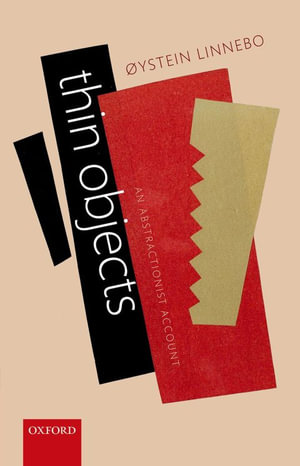
Thin Objects : An Abstractionist Account - Øystein Linnebo

Thin Objects

An Abstractionist Account

By: Øystein Linnebo

eText | 23 May 2018

At a Glance

eText


$73.65

or 4 interest-free payments of $18.41 with

 or 

Instant online reading in your Booktopia eTextbook Library *

Why choose an eTextbook?

Instant Access *

Purchase and read your book immediately

Read Aloud

Listen and follow along as Bookshelf reads to you

Study Tools

Built-in study tools like highlights and more

* eTextbooks are not downloadable to your eReader or an app and can be accessed via web browsers only. You must be connected to the internet and have no technical issues with your device or browser that could prevent the eTextbook from operating.

Are there objects that are "thin" in the sense that not very much is required for their existence? Frege famously thought so. He claimed that the equinumerosity of the knives and the forks suffices for there to be objects such as the number of knives and the number of forks, and for these objects to be identical. The idea of thin objects holds great philosophical promise but has proved hard to explicate. Øystein Linnebo aims to do so by drawing on some Fregean ideas. First, to be an object is to be a possible referent of a singular term. Second, singular reference can be achieved by providing a criterion of identity for the would-be referent. The second idea enables a form of easy reference and thus, via the first idea, also a form of easy being. Paradox is avoided by imposing a predicativity restriction on the criteria of identity. But the abstraction based on a criterion of identity may result in an expanded domain. By iterating such expansions, a powerful account of dynamic abstraction is developed. The result is a distinctive approach to ontology. Abstract objects such as numbers and sets are demystified and allowed to exist alongside more familiar physical objects. And Linnebo also offers a novel approach to set theory which takes seriously the idea that sets are "formed" successively.

on
Desktop
Tablet
Mobile

More in Philosophy & Logic

The Rules of Logic : Library of Arabic Literature - Najm al-D?n al-K?tib?

eBOOK

Symbol Of The World - Kristina Kichigina

eBOOK

Mind Path - Salim Can Akyürek

eBOOK

$6.99