Get Free Shipping on orders over $79
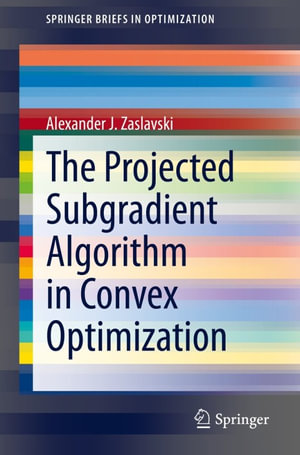
The Projected Subgradient Algorithm in Convex Optimization : SpringerBriefs in Optimization - Alexander J. Zaslavski

The Projected Subgradient Algorithm in Convex Optimization

By: Alexander J. Zaslavski

eText | 25 November 2020

At a Glance

eText


$84.99

or 4 interest-free payments of $21.25 with

 or 

Instant online reading in your Booktopia eTextbook Library *

Why choose an eTextbook?

Instant Access *

Purchase and read your book immediately

Read Aloud

Listen and follow along as Bookshelf reads to you

Study Tools

Built-in study tools like highlights and more

* eTextbooks are not downloadable to your eReader or an app and can be accessed via web browsers only. You must be connected to the internet and have no technical issues with your device or browser that could prevent the eTextbook from operating.

This focused monograph presents a study of subgradient algorithms for constrained minimization problems in a Hilbert space. The book is of interest for experts in applications of optimization to engineering and economics. The goal is to obtain a good approximate solution of the problem in the presence of computational errors. The discussion takes into consideration the fact that for every algorithm its iteration consists of several steps and that computational errors for di?erent steps are di?erent, in general. The book is especially useful for the reader because it contains solutions to a number of difficult and interesting problems in the numerical optimization. The subgradient projection algorithm is one of the most important tools in optimization theory and its applications. An optimization problem is described by an objective function and a set of feasible points. For this algorithm each iteration consists of two steps. The first step requires a calculation of a subgradient of the objective function; the second requires a calculation of a projection on the feasible set. The computational errors in each of these two steps are different. This book shows that the algorithm discussed, generates a good approximate solution, if all the computational errors are bounded from above by a small positive constant. Moreover, if computational errors for the two steps of the algorithm are known, one discovers an approximate solution and how many iterations one needs for this. In addition to their mathematical interest, the generalizations considered in this book have a significant practical meaning.

on
Desktop
Tablet
Mobile

More in Numerical Analysis

An Introduction to Applied Numerical Analysis - M Ali Hooshyar

eBOOK

Guide to Analysis : Mathematical Guides - Mary Hart

eBOOK

RRP $125.99

$113.99

10%
OFF
The Fractal Unity - Evolve By Love

eBOOK