Get Free Shipping on orders over $79
Syntax-based Statistical Machine Translation - Philip Williams

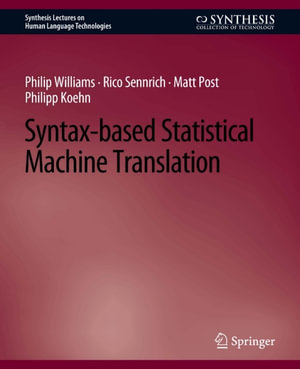
Syntax-based Statistical Machine Translation

By: Philip Williams, Rico Sennrich, Matt Post, Philipp Koehn

eText | 31 May 2022

At a Glance

eText


$84.99

or 4 interest-free payments of $21.25 with

 or 

Instant online reading in your Booktopia eTextbook Library *

Why choose an eTextbook?

Instant Access *

Purchase and read your book immediately

Read Aloud

Listen and follow along as Bookshelf reads to you

Study Tools

Built-in study tools like highlights and more

* eTextbooks are not downloadable to your eReader or an app and can be accessed via web browsers only. You must be connected to the internet and have no technical issues with your device or browser that could prevent the eTextbook from operating.
This unique book provides a comprehensive introduction to the most popular syntax-based statistical machine translation models, filling a gap in the current literature for researchers and developers in human language technologies. While phrase-based models have previously dominated the field, syntax-based approaches have proved a popular alternative, as they elegantly solve many of the shortcomings of phrase-based models. The heart of this book is a detailed introduction to decoding for syntax-based models. The book begins with an overview of synchronous-context free grammar (SCFG) and synchronous tree-substitution grammar (STSG) along with their associated statistical models. It also describes how three popular instantiations (Hiero, SAMT, and GHKM) are learned from parallel corpora. It introduces and details hypergraphs and associated general algorithms, as well as algorithms for decoding with both tree and string input. Special attention is given to efficiency, including search approximations such as beam search and cube pruning, data structures, and parsing algorithms. The book consistently highlights the strengths (and limitations) of syntax-based approaches, including their ability to generalize phrase-based translation units, their modeling of specific linguistic phenomena, and their function of structuring the search space.
on
Desktop
Tablet
Mobile

More in Artificial Intelligence

Medium Hot : Images in the Age of Heat - Hito Steyerl

eBOOK

RRP $22.66

$18.99

16%
OFF
AI Futures - Evgeny Morozov

eBOOK

RRP $16.88

$13.99

17%
OFF
AI-Powered Search - Trey Grainger

eBOOK

HBR Guide to Generative AI for Managers : HBR Guide - Elisa Farri

eBOOK

The Microeconomics of Artificial Intelligence - Joshua Gans

eBOOK