



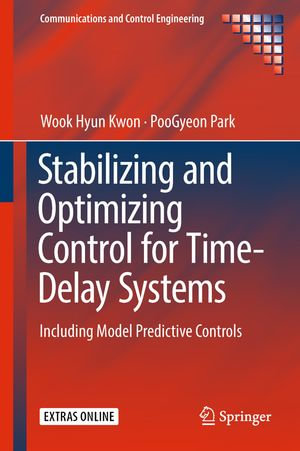
Stabilizing and Optimizing Control for Time-Delay Systems
Including Model Predictive Controls
By: Wook Hyun Kwon, PooGyeon Park
eText | 6 July 2018
At a Glance
eText
$159.01
or
Instant online reading in your Booktopia eTextbook Library *
Why choose an eTextbook?
Instant Access *
Purchase and read your book immediately
Read Aloud
Listen and follow along as Bookshelf reads to you
Study Tools
Built-in study tools like highlights and more
* eTextbooks are not downloadable to your eReader or an app and can be accessed via web browsers only. You must be connected to the internet and have no technical issues with your device or browser that could prevent the eTextbook from operating.
ISBN: 9783319927046
ISBN-10: 3319927043
Series: Intelligent Technologies and Robotics (R0)
Published: 6th July 2018
Format: ePUB
Language: English
Publisher: Springer International Publishing
You Can Find This eBook In
Non-FictionEngineering & TechnologyElectronics & Communications EngineeringElectronics EngineeringAutomatic Control EngineeringReference, Information & Interdisciplinary SubjectsResearch & InformationInformation theoryCybernetics & Systems TheoryMathematicsApplied MathematicsIndustrial Chemistry & Manufacturing Technologies


This product is categorised by
- Non-FictionEngineering & TechnologyElectronics & Communications EngineeringElectronics EngineeringAutomatic Control Engineering
- Non-FictionReference, Information & Interdisciplinary SubjectsResearch & InformationInformation theoryCybernetics & Systems Theory
- Non-FictionMathematicsApplied Mathematics
- Non-FictionEngineering & TechnologyIndustrial Chemistry & Manufacturing TechnologiesIndustrial Chemistry
- Non-FictionMathematicsOptimisation
- Non-FictionLibrary & Info SciencesLibrary & Information Services
- Non-FictionEngineering & TechnologyEnergy Technology & EngineeringElectrical Engineering