

Get Free Shipping on orders over $79
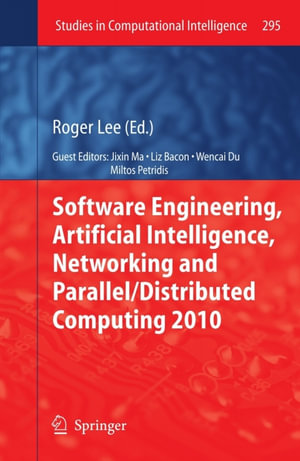
Software Engineering, Artificial Intelligence, Networking and Parallel/Distributed Computing 2010 - Roger Lee

Software Engineering, Artificial Intelligence, Networking and Parallel/Distributed Computing 2010

By: Roger Lee

eText | 11 May 2010 | Edition Number 1

At a Glance

eText


$159.01

or 4 interest-free payments of $39.75 with

 or 

Instant online reading in your Booktopia eTextbook Library *

Why choose an eTextbook?

Instant Access *

Purchase and read your book immediately

Read Aloud

Listen and follow along as Bookshelf reads to you

Study Tools

Built-in study tools like highlights and more

* eTextbooks are not downloadable to your eReader or an app and can be accessed via web browsers only. You must be connected to the internet and have no technical issues with your device or browser that could prevent the eTextbook from operating.
th The purpose of the 11 Conference on Software Engineering, Artificial Intelligence, Networking, and Parallel/Distributed Computing (SNPD 2010) held on June 9 - 11, 2010 in London, United Kingdom was to bring together researchers and scientists, businessmen and entrepreneurs, teachers and students to discuss the numerous fields of computer science, and to share ideas and information in a meaningful way. Our conference officers selected the best 15 papers from those papers accepted for presentation at the conference in order to publish them in this volume. The papers were chosen based on review scores submitted by members of the program committee, and underwent further rounds of rigorous review. In Chapter 1, Cai Luyuan et al. Present a new method of shape decomposition based on a refined morphological shape decomposition process. In Chapter 2, Kazunori Iwata et al. propose a method for reducing the margin of error in effort and error prediction models for embedded software development projects using artificial neural networks (ANNs). In Chapter 3, Viliam Šimko et al. describe a model-driven tool that allows system code to be generated from use-cases in plain English. In Chapter 4, Abir Smiti and Zied Elouedi propose a Case Base Maintenance (CBM) method that uses machine learning techniques to preserve the maximum competence of a system. In Chapter 5, Shagufta Henna and Thomas Erlebach provide a simulation based analysis of some widely used broadcasting schemes within mobile ad hoc networks (MANETs) and propose adaptive extensions to an existing broadcasting algorithm.
on
Desktop
Tablet
Mobile

More in Engineering in General

SAFE : Science and Technology in the Age of Ter - Martha Baer

eBOOK

Star Commercial Spaces - Julio Fajardo

eBOOK

The Shabby Chic Home - Rachel Ashwell

eBOOK

Shabby Chic - Rachel Ashwell

eBOOK

$17.99