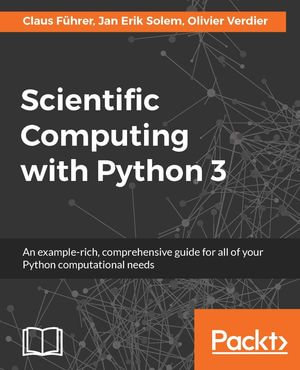
An example-rich, comprehensive guide for all of your Python computational needs
About This Book
- Your ultimate resource for getting up and running with Python numerical computations
- Explore numerical computing and mathematical libraries using Python 3.x code with SciPy and NumPy modules
- A hands-on guide to implementing mathematics with Python, with complete coverage of all the key concepts
Who This Book Is For
This book is for anyone who wants to perform numerical and mathematical computations in Python. It is especially useful for developers, students, and anyone who wants to use Python for computation. Readers are expected to possess basic a knowledge of scientific computing and mathematics, but no prior experience with Python is needed.
What You Will Learn
- The principal syntactical elements of Python
- The most important and basic types in Python
- The essential building blocks of computational mathematics, linear algebra, and related Python objects
- Plot in Python using matplotlib to create high quality figures and graphics to draw and visualize your results
- Define and use functions and learn to treat them as objects
- How and when to correctly apply object-oriented programming for scientific computing in Python
- Handle exceptions, which are an important part of writing reliable and usable code
- Two aspects of testing for scientific programming: Manual and Automatic
In Detail
Python can be used for more than just general-purpose programming. It is a free, open source language and environment that has tremendous potential for use within the domain of scientific computing. This book presents Python in tight connection with mathematical applications and demonstrates how to use various concepts in Python for computing purposes, including examples with the latest version of Python 3. Python is an effective tool to use when coupling scientific computing and mathematics and this book will teach you how to use it for linear algebra, arrays, plotting, iterating, functions, polynomials, and much more.
Style and approach
This book takes a concept-based approach to the language rather than a systematic introduction. It is a complete Python tutorial and introduces computing principles, using practical examples to and showing you how to correctly implement them in Python. You'll learn to focus on high-level design as well as the intricate details of Python syntax. Rather than providing canned problems to be solved, the exercises have been designed to inspire you to think about your own code and give you real-world insight.