

Get Free Shipping on orders over $79
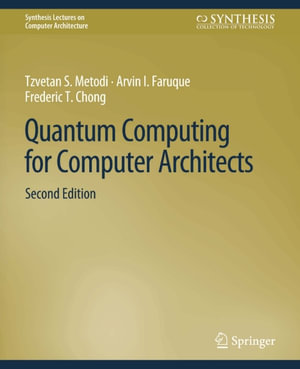
Quantum Computing for Computer Architects, Second Edition - Tzvetan Metodi

Quantum Computing for Computer Architects, Second Edition

By: Tzvetan Metodi, Arvin I. Faruque

eText | 1 June 2022 | Edition Number 2

At a Glance

eText


$64.99

or 4 interest-free payments of $16.25 with

 or 

Instant online reading in your Booktopia eTextbook Library *

Why choose an eTextbook?

Instant Access *

Purchase and read your book immediately

Read Aloud

Listen and follow along as Bookshelf reads to you

Study Tools

Built-in study tools like highlights and more

* eTextbooks are not downloadable to your eReader or an app and can be accessed via web browsers only. You must be connected to the internet and have no technical issues with your device or browser that could prevent the eTextbook from operating.
Quantum computers can (in theory) solve certain problems far faster than a classical computer running any known classical algorithm. While existing technologies for building quantum computers are in their infancy, it is not too early to consider their scalability and reliability in the context of the design of large-scale quantum computers. To architect such systems, one must understand what it takes to design and model a balanced, fault-tolerant quantum computer architecture. The goal of this lecture is to provide architectural abstractions for the design of a quantum computer and to explore the systems-level challenges in achieving scalable, fault-tolerant quantum computation. In this lecture, we provide an engineering-oriented introduction to quantum computation with an overview of the theory behind key quantum algorithms. Next, we look at architectural case studies based upon experimental data and future projections for quantum computation implemented using trapped ions. While we focus here on architectures targeted for realization using trapped ions, the techniques for quantum computer architecture design, quantum fault-tolerance, and compilation described in this lecture are applicable to many other physical technologies that may be viable candidates for building a large-scale quantum computing system. We also discuss general issues involved with programming a quantum computer as well as a discussion of work on quantum architectures based on quantum teleportation. Finally, we consider some of the open issues remaining in the design of quantum computers. Table of Contents: Introduction / Basic Elements for Quantum Computation / Key Quantum Algorithms / Building Reliable and Scalable Quantum Architectures / Simulation of Quantum Computation / Architectural Elements / Case Study: The Quantum Logic Array Architecture / Programming the Quantum Architecture / Using the QLA for Quantum Simulation: The Transverse Ising Model / Teleportation-Based Quantum Architectures / Concluding Remarks
on
Desktop
Tablet
Mobile

More in Circuits & Components