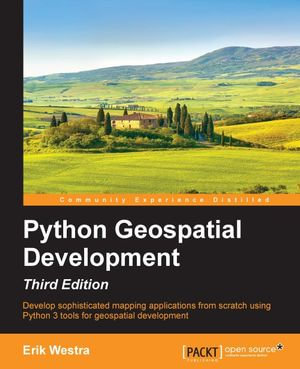
Develop sophisticated mapping applications from scratch using Python 3 tools for geospatial development
About This Book
- Build web applications based around maps and geospatial data using Python 3.x
- Install and use various toolkits and obtain geospatial data for use in your programs
- This practical, hands-on book will teach you all about geospatial development in Python
Who This Book Is For
This book is for experienced Python developers who want to learn about geospatial concepts, obtain and work with geospatial data, solve spatial problems, and build sophisticated map-based applications using Python.
What You Will Learn
- Access, manipulate, and display geospatial data from within your Python programs
- Master the core geospatial concepts of location, distance, units, projections, and datums
- Read and write geospatial data in both vector and raster format
- Perform complex, real-world geospatial calculations using Python
- Store and access geospatial information in a database
- Use points, lines, and polygons within your Python programs
- Convert geospatial data into attractive maps using Python-based tools
- Build complete web-based mapping applications using Python
In Detail
Geospatial development links your data to locations on the surface of the Earth. Writing geospatial programs involves tasks such as grouping data by location, storing and analyzing large amounts of spatial information, performing complex geospatial calculations, and drawing colorful interactive maps. In order to do this well, you'll need appropriate tools and techniques, as well as a thorough understanding of geospatial concepts such as map projections, datums, and coordinate systems.
This book provides an overview of the major geospatial concepts, data sources, and toolkits. It starts by showing you how to store and access spatial data using Python, how to perform a range of spatial calculations, and how to store spatial data in a database. Further on, the book teaches you how to build your own slippy map interface within a web application, and finishes with the detailed construction of a geospatial data editor using the GeoDjango framework.
By the end of this book, you will be able to confidently use Python to write your own geospatial applications ranging from quick, one-off utilities to sophisticated web-based applications using maps and other geospatial data.
Style and approach
This book is a comprehensive course in geospatial development. The concepts you need to know are presented in a hands-on fashion with example code to help you to solve real-world problems right away. Larger programs are built up step by step while guiding you through the process of building your own sophisticated mapping applications.