



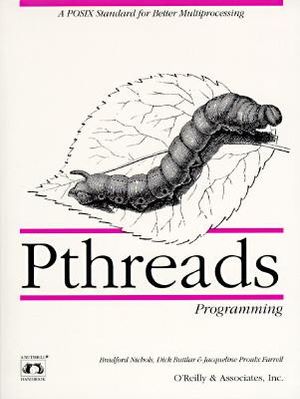
Pthreads Programming
A Posix Standard for Better Multiprocessing
By: Bradford Nichols
Paperback | 1 September 1996
At a Glance
Paperback
RRP $76.00
$39.75
48%OFF
ISBN: 9781565921153
ISBN-10: 1565921151
Series: A Nutshell handbook
Published: 1st September 1996
Format: Paperback
Language: English
Number of Pages: 284
Audience: General Adult
Publisher: John Wiley & Sons UK
Country of Publication: GB
Dimensions (cm): 22.86 x 19.05 x 1.27
Weight (kg): 0.39
Shipping
| Standard Shipping | Express Shipping | |
|---|---|---|
| Metro postcodes: | $9.99 | $14.95 |
| Regional postcodes: | $9.99 | $14.95 |
| Rural postcodes: | $9.99 | $14.95 |
How to return your order
At Booktopia, we offer hassle-free returns in accordance with our returns policy. If you wish to return an item, please get in touch with Booktopia Customer Care.
Additional postage charges may be applicable.
Defective items
If there is a problem with any of the items received for your order then the Booktopia Customer Care team is ready to assist you.
For more info please visit our Help Centre.
You Can Find This Book In

RRP $100.00
$69.75
OFF


RRP $89.99
$64.99
OFF


RRP $107.04
$75.75
OFF

RRP $41.95
$33.75
OFF

RRP $49.95
$34.99
OFF

RRP $91.30
$65.75
OFF
RRP $57.95
$44.75
OFF
RRP $37.99
$30.75
OFF

RRP $39.99
$33.75
OFF
RRP $74.95
$55.75
OFF


RRP $43.75
$24.75
OFF
RRP $152.00
$73.75
OFF

RRP $152.00
$73.75
OFF
This product is categorised by
- Non-FictionComputing & I.T.Operating SystemsUNIX
- Non-FictionComputing & I.T.Operating SystemsLinux
- Non-FictionComputing & I.T.Computer ScienceComputer Architecture & Logic DesignParallel Processing
- Non-FictionComputing & I.T.Computer Programming & Software DevelopmentWeb Programming
- Booktopia Publisher ServicesJohn Wiley & Sons Publishers UK
- Non-FictionComputing & I.T.Computer Programming & Software DevelopmentSoftware Engineering