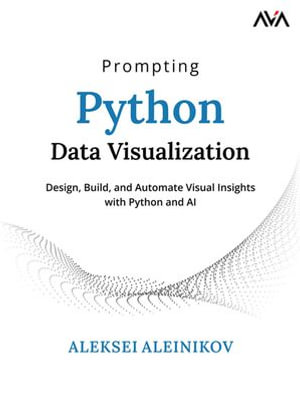
Turn natural language into production-ready Python charts
Key Features
? Get a free one-month digital subscription to www.avaskillshelf.com
? End-to-end Python visualization workflow, from data handling to production.
? Hands-on Matplotlib and Seaborn mastery, from fundamentals to advanced use.
? AI-powered visualization workflows using prompts, automation, and templates.
Book Description
Data visualization turns complex data into insight, alignment, and action—and it is a core skill for modern data, analytics, and engineering roles. Prompting Python Data Visualization shows you how to design clear, trustworthy visuals in Python, while accelerating the entire workflow by translating natural-language intent into working visualization code with AI.
You begin with the foundations of visual thinking and data handling, then build strong technical skills using Matplotlib and Seaborn. The book takes you from basic plots to advanced layouts, styling, annotations, time-series analysis, and publication-ready exports, grounded in real-world analytics and reporting use cases.
As you progress, you learn prompt engineering techniques to generate charts with AI, refine and debug AI-produced code, and automate repetitive visualization tasks using reusable prompt templates. By the end of the book, you will produce professional visuals for reports, notebooks, and dashboards with speed, consistency, and confidence.
What you will learn
? Apply visual thinking principles to design meaningful charts
? Build and customize Matplotlib visualizations for real-world use
? Use Seaborn to explore distributions, categories, and relationships
? Prepare Python visualizations for reports, dashboards, and publications
? Generate, refine, and automate plots using AI-driven prompts
? Apply ethical data storytelling and future-ready visualization practices
Who is This Book For?
This book is for Python Developers, Data Analysts, Data Scientists, Machine Learning Engineers, Business Intelligence Engineers, and Analytics Engineers who want to create professional, production-ready visualizations and accelerate their workflow using AI.
Readers should have a working knowledge of Python (functions, lists, dictionaries, NumPy/Pandas or DataFrames) and basic experience working with datasets.
Table of Contents
1. The Foundation of Visual Thinking
2. Setting Up Your Visualization Environment
3. Data Handling Essentials
4. Matplotlib Fundamentals
5. Customizing Matplotlib Aesthetics
6. Arranging Matplotlib Plots
7. Advanced Matplotlib Techniques
8. Preparing Matplotlib for Production
9. Introduction to Seaborn
10. Seaborn for Distribution and Categorical Data
11. Seaborn for Relationships and Matrix Plots
12. Advanced Seaborn Features
13. Prompting for Visualization Code
14. Refining AI-Generated Visualizations
15. Automation with AI Prompts
16. Building Reusable Prompt Templates
17. Data Storytelling and Ethics
18. The Future of Visualization AI
Index
About the Author
Aleksei Aleinikov is a Senior Platform and Cloud Engineer specializing in security-first cloud architecture and scalable systems. He builds reliable Python analytics and visualization workflows, focusing on IAM, observability, and operational rigor, and actively shares hands-on engineering insights with the developer community.