Get Free Shipping on orders over $79
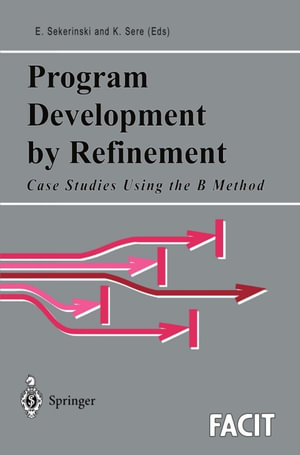
Program Development by Refinement : Case Studies Using the B Method - Emil Sekerinski

Program Development by Refinement

Case Studies Using the B Method

By: Emil Sekerinski, Kaisa Sere

eText | 6 December 2012 | Edition Number 1

At a Glance

eText


$319.00

or 4 interest-free payments of $79.75 with

 or 

Instant online reading in your Booktopia eTextbook Library *

Why choose an eTextbook?

Instant Access *

Purchase and read your book immediately

Read Aloud

Listen and follow along as Bookshelf reads to you

Study Tools

Built-in study tools like highlights and more

* eTextbooks are not downloadable to your eReader or an app and can be accessed via web browsers only. You must be connected to the internet and have no technical issues with your device or browser that could prevent the eTextbook from operating.
The Idea of Program Refinement Programs are complex. They are typically so complex, that they go beyond the full comprehension even of the programmer or team who designed them, with all the consequences this has. How can we cope with such complexity in a satisfactory way? An approach, advocated for a long time, is to separate a concise specification of a program - the "what" - from a possibly involved implementation - the "how". Once a specification is obtained from the set of requirements on the program, there can still be a large gap to an efficient implementation. The development from specification to implementation can then proceed by a succession oflayers, such that each layer is a refinement of the previous one. Design decisions can be introduced in refinement steps one at a time. By this, the refinement steps can be kept small and manageable. Still, the set of all requirements can be far too large to be taken completely into account in the initial specification. Even if they could, they might obscure issues more than clarify them. For example: • An information system for stored goods needs to produce an error message on il­ legal input. Yet, the exact wording - and even the language - of those messages is irrelevant for an understanding of the essence of the system. • A banking application interacts with customers with a graphical interface. Yet the specification of the graphical layout is secondary compared to the specification of the possible transactions.
on
Desktop
Tablet
Mobile

More in Software Engineering

The End of Leadership - Barbara Kellerman

eBOOK

The Debugging Handbook - Johannes Kuhlmann

eBOOK

RRP $67.55

$54.99

19%
OFF
API Management with Bruno - Lyria Tharax

eBOOK

Essential n8n Playbook - Leandro Calado

eBOOK