Get Free Shipping on orders over $79
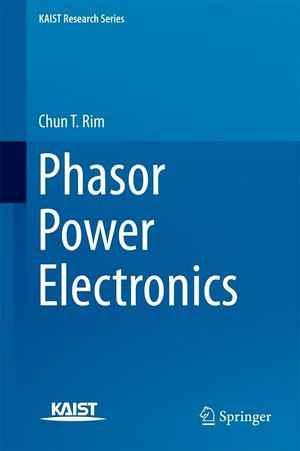
Phasor Power Electronics : KAIST Research Series - Chun T. Rim

Phasor Power Electronics

By: Chun T. Rim

eText | 29 March 2016

At a Glance

eText


$239.00

or 4 interest-free payments of $59.75 with

 or 

Instant online reading in your Booktopia eTextbook Library *

Why choose an eTextbook?

Instant Access *

Purchase and read your book immediately

Read Aloud

Listen and follow along as Bookshelf reads to you

Study Tools

Built-in study tools like highlights and more

* eTextbooks are not downloadable to your eReader or an app and can be accessed via web browsers only. You must be connected to the internet and have no technical issues with your device or browser that could prevent the eTextbook from operating.

This book presents a comprehensive introduction to the principles of power electronics, focusing on the switched transformer concept and phasor transformation techniques as employed in the analysis and design of power electronic circuits. Phasor transformations, as introduced in this book, make the time-varying nature of a switching converter simple and easy to handle, transforming it into an equivalent time-invariant circuit.

The book starts with an introduction to the philosophy and fundamental principles of power electronics. The switched transformer concept, which is applicable to any switching converter, is introduced, and it is shown how DC-DC converters analyses are then so straightforward that very little equational manipulation is needed. Then the phasor transformation techniques are comprehensively explained over three parts. Single phase and multi-phase AC systems are dealt with through the single phase phasor transformation and circuit DQ transformation, respectively. A general unified phasor transformation is then introduced for the static and dynamic cases. The final part of the book considers current and potential extensions of the technique in various fields of application, including wireless power transfer, signal processing, power systems and renewable energy.

The book avoids the piece-wise linear circuit models used in other titles, with which the mathematical results become too complicated to be used in practice. No cumbersome equations or matrix manipulations are needed with the phasor transformation techniques introduced in this book. It will be a valuable reference source for engineering students and practising researchers in power electronics and related areas.

on
Desktop
Tablet
Mobile

More in Circuits & Components