Get Free Shipping on orders over $89
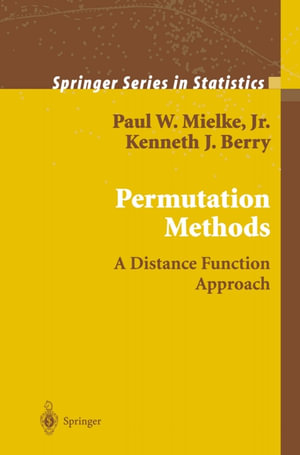
Permutation Methods : A Distance Function Approach - Paul W. Mielke Jr.

Permutation Methods

A Distance Function Approach

By: Paul W. Mielke Jr., Kenneth J. Berry

eText | 29 June 2013

At a Glance

eText


$129.00

or 4 interest-free payments of $32.25 with

 or 

Instant online reading in your Booktopia eTextbook Library *

Why choose an eTextbook?

Instant Access *

Purchase and read your book immediately

Read Aloud

Listen and follow along as Bookshelf reads to you

Study Tools

Built-in study tools like highlights and more

* eTextbooks are not downloadable to your eReader or an app and can be accessed via web browsers only. You must be connected to the internet and have no technical issues with your device or browser that could prevent the eTextbook from operating.
The introduction of permutation tests by R. A. Fisher relaxed the paramet­ ric structure requirement of a test statistic. For example, the structure of the test statistic is no longer required if the assumption of normality is removed. The between-object distance function of classical test statis­ tics based on the assumption of normality is squared Euclidean distance. Because squared Euclidean distance is not a metric (i. e. , the triangle in­ equality is not satisfied), it is not at all surprising that classical tests are severely affected by an extreme measurement of a single object. A major purpose of this book is to take advantage of the relaxation of the struc­ ture of a statistic allowed by permutation tests. While a variety of distance functions are valid for permutation tests, a natural choice possessing many desirable properties is ordinary (i. e. , non-squared) Euclidean distance. Sim­ ulation studies show that permutation tests based on ordinary Euclidean distance are exceedingly robust in detecting location shifts of heavy-tailed distributions. These tests depend on a metric distance function and are reasonably powerful for a broad spectrum of univariate and multivariate distributions. Least sum of absolute deviations (LAD) regression linked with a per­ mutation test based on ordinary Euclidean distance yields a linear model analysis which controls for type I error.
on
Desktop
Tablet
Mobile

More in Probability & Statistics

All of Regression - Isabella Verdinelli

eTEXT

$104.95

Bayesian Workflow - Andrew Gelman

eTEXT

$116.60