Get Free Shipping on orders over $79
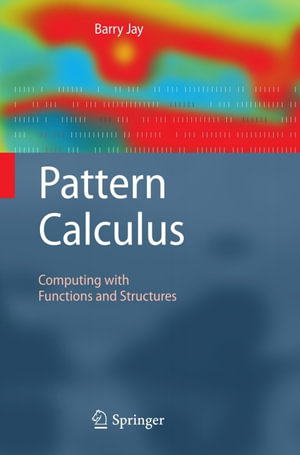
Pattern Calculus : Computing with Functions and Structures - Barry Jay

Pattern Calculus

Computing with Functions and Structures

By: Barry Jay

eText | 30 July 2009

At a Glance

eText


$269.01

or 4 interest-free payments of $67.25 with

 or 

Instant online reading in your Booktopia eTextbook Library *

Why choose an eTextbook?

Instant Access *

Purchase and read your book immediately

Read Aloud

Listen and follow along as Bookshelf reads to you

Study Tools

Built-in study tools like highlights and more

* eTextbooks are not downloadable to your eReader or an app and can be accessed via web browsers only. You must be connected to the internet and have no technical issues with your device or browser that could prevent the eTextbook from operating.
Over time, basic research tends to lead to specialization - increasingly narrow t- ics are addressed by increasingly focussed communities, publishing in increasingly con ned workshops and conferences, discussing increasingly incremental contri- tions. Already the community of programming languages is split into various s- communities addressing different aspects and paradigms (functional, imperative, relational, and object-oriented). Only a few people manage to maintain a broader view, and even fewer step back in order to gain an understanding about the basic principles, their interrelation, and their impact in a larger context. The pattern calculus is the result of a profound re-examination of a 50-year - velopment. It attempts to provide a unifying approach, bridging the gaps between different programming styles and paradigms according to a new slogan - compu- tion is pattern matching. It is the contribution of this book to systematically and elegantly present and evaluate the power of pattern matching as the guiding paradigm of programming. Patterns are dynamically generated, discovered, passed, applied, and automatically adapted, based on pattern matching and rewriting technology, which allows one to elegantly relate things as disparate as functions and data structures. Of course, pattern matching is not new. It underlies term rewriting - it is, for example, inc- porated in, typically functional, programming languages, like Standard ML - but it has never been pursued as the basis of a unifying framework for programming.
on
Desktop
Tablet
Mobile

More in Software Engineering

The End of Leadership - Barbara Kellerman

eBOOK

The Debugging Handbook - Johannes Kuhlmann

eBOOK

RRP $67.55

$54.99

19%
OFF
API Management with Bruno - Lyria Tharax

eBOOK

Essential n8n Playbook - Leandro Calado

eBOOK