Get Free Shipping on orders over $79
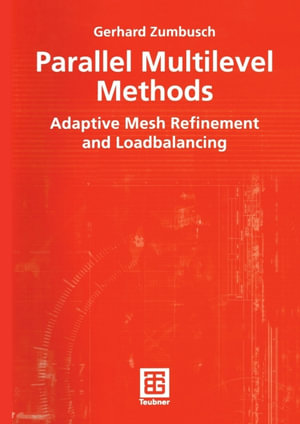
Parallel Multilevel Methods : Adaptive Mesh Refinement and Loadbalancing - Gerhard Zumbusch

Parallel Multilevel Methods

Adaptive Mesh Refinement and Loadbalancing

By: Gerhard Zumbusch

eText | 6 December 2012

At a Glance

eText


$64.99

or 4 interest-free payments of $16.25 with

 or 

Instant online reading in your Booktopia eTextbook Library *

Why choose an eTextbook?

Instant Access *

Purchase and read your book immediately

Read Aloud

Listen and follow along as Bookshelf reads to you

Study Tools

Built-in study tools like highlights and more

* eTextbooks are not downloadable to your eReader or an app and can be accessed via web browsers only. You must be connected to the internet and have no technical issues with your device or browser that could prevent the eTextbook from operating.
Numerical simulation promises new insight in science and engineering. In ad­ dition to the traditional ways to perform research in science, that is laboratory experiments and theoretical work, a third way is being established: numerical simulation. It is based on both mathematical models and experiments con­ ducted on a computer. The discipline of scientific computing combines all aspects of numerical simulation. The typical approach in scientific computing includes modelling, numerics and simulation, see Figure l. Quite a lot of phenomena in science and engineering can be modelled by partial differential equations (PDEs). In order to produce accurate results, complex models and high resolution simulations are needed. While it is easy to increase the precision of a simulation, the computational cost of doing so is often prohibitive. Highly efficient simulation methods are needed to overcome this problem. This includes three building blocks for computational efficiency, discretisation, solver and computer. Adaptive mesh refinement, high order and sparse grid methods lead to discretisations of partial differential equations with a low number of degrees of freedom. Multilevel iterative solvers decrease the amount of work per degree of freedom for the solution of discretised equation systems. Massively parallel computers increase the computational power available for a single simulation.
on
Desktop
Tablet
Mobile

More in Calculus & Mathematical Analysis

AI Breaking Boundaries - Avinash Vanam

eBOOK

The Monodromy Group - Henryk ?o??dek

eTEXT

Enriques Surfaces I - François Cossec

eTEXT